Showing posts with label St. John Chrysostom. Show all posts

Sunday, 28 April 2019

THE STONE ROLLED AWAY. EXEGESIS ON JOHN 20:2


The first day of the week(that is, the Lords day) comes Mary Magdalene, very early in the THE STONE ROLLED AWAY. EXEGESIS ON JOHN 20:2  and sees the stone taken away from the sepulcher.
For He arose while both stone and seals lay over Him; but because it was necessary that others should be fully satisfied, the tomb was opened after the Resurrection, and thus what had come to pass was confirmed. This then was what moved Mary. For being entirely full of loving affection towards her Master, when the Sabbath was past, she could not bear to rest, but came very early in the morning, desiring to find some consolation from the place. But when she saw the place, and the stone taken away, she neither entered in nor stooped down, but ran to the disciples, in the greatness of her longing; for this was what she earnestly desired, she wished very speedily to learn what had become of the body. This was the meaning of her running, and her words declare it.
They have taken away, she says, my Lord, and I know not where they have laid Him.

Sunday, 1 March 2015

The Triumph of the Church

by St. John Chrysostom

"How does one prove that Christ is God? We should not try to answer this question by using the argument of the creation of heaven and earth, because the unbeliever will not accept it. If we tell him that He raised the dead, healed the blind, expelled demons, he still will not agree. If we tell him that He promised us resurrection from the dead, the kingdom of heaven, and ineffable goods, not only he will not agree, but also he will laugh at us. 

How then shall we lead him to the faith, especially when he is not spiritually developed? Surely, we shall do this by resting on truths which are acceptable both to us and to him without any dispute or shadow of doubt. 

Thursday, 20 February 2014

Homily For Judgement Sunday

St John Chrysostom

(Homily LXXIX: 
Matthew 25: 31-41)

Unto this most delightful portion of Scripture, which we do not cease continually revolving, let us now listen with all earnestness and compunction, this wherewith His discourse ended, even as the last thing, reasonably; for great indeed was His regard for philanthropy and mercy. Wherefore in what precedes He had discoursed concerning this in a different way; and here now in some respects more clearly, and more earnestly, not setting forth two nor three nor five persons, but the whole world; although most assuredly the former places, which speak of two persons, meant not two persons, but two portions of mankind, one of them that disobey, the other of the obedient. But here He handleth the word more fearfully, and with fuller light. Wherefore neither doth He say, "The kingdom is likened," any more, but openly shows Himself, saying, "When the Son of Man shall come in His glory." For now is He come in dishonor, now in affronts and reproaches; but then shall He sit upon the throne of His glory. And continually doth He make mention of glory. For since the cross was near, a thing that seemed to be matter of reproach, for this cause He raises up the hearer; and brings before his sight the judgment seat, and setteth round him all the world. And not in this way only doth He make His discourse awful, but also by showing the Heavens opened.

Friday, 3 May 2013

St. John Chrysostom on the Holy Cross

"The Cross of the Lord is unpleasant and sorrowful to the ear, but it consists of joy and gladness. It is the originator not so much of suffering as much as of passionlessness. For Jews the Cross is temptation, for pagans it is madness, but for us believers it reminds us of our salvation. When in church one reads about the Cross and one is reminded of the sufferings on the Cross, the faithful are indignant at the Cross and let out a plaintive wail and murmur not at the Cross but at the crucifiers and unbelievers. For the Cross is the salvation of the Church, the Cross is the praise of those who hope on it.

Thursday, 2 May 2013

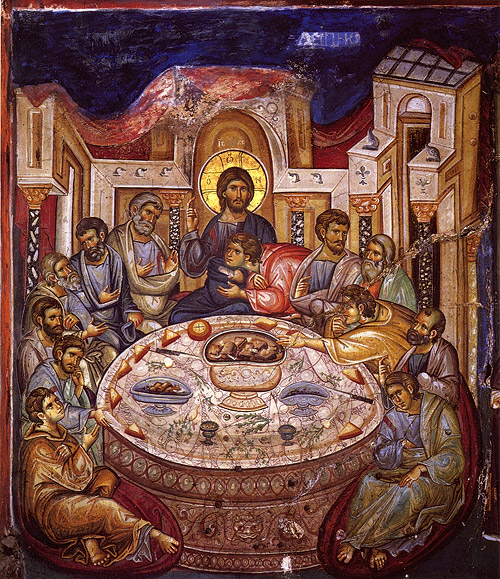
HOLY AND GREAT THURSDAY
Commemoration of the Mystical 
(Last) Supper

And as they were eating, Jesus took bread, and blessed it, and brake it, and gave it to the disciples, and said, Take, eat; this is my body. And he took the cup, and gave thanks, and gave it to them, saying, Drink ye all of it; For this is my blood of the new testament, which is shed for many for the remission of sins.
Mt. 26:26–28

On the day of the feast of unleavened bread, when according to the Law of the Old Testament a lamb was to be slaughtered and eaten, the hour was come that the Savior should depart out of this world unto the Father (cf. Jn. 13:1). Having come to fulfill the law, Jesus Christ sent His disciples, Peter and John, to Jerusalem to prepare the Passover, which, as the shadow of the law, He wanted to exchange it with the New Pascha—His own Body and Blood. When evening had come, the Lord came with His twelve disciples to a large, prepared upper room of a man who lived in Jerusalem (cf. Mk. 14:12–17) and reclined there.

Tuesday, 30 April 2013


3 Holy Fathers On the Parable of the Ten Virgins

Saint Macarios the Great

The five wise virgins, watchful and alert, had taken oil in the vessels of their heart. That oil, not part of their own nature, means the grace of the Spirit. They were enabled to enter with the Bridegroom into the heavenly bridal chamber.

Saturday, 27 April 2013

Homilies on Hebrews (Chrysostom)
Hebrews 12:28-29

 Wherefore we receiving a kingdom which cannot be moved, let us have grace [or gratitude,] whereby we serve God acceptably with reverence and godly fear. For our God is a consuming fire.


Homilies on the Gospel of John (Chrysostom)

John 11:1-2
Now a certain man was sick, named Lazarus, of Bethany, of the town of Mary and her sister Martha. It was that Mary which anointed the Lord with ointment.

Saturday, 20 April 2013


St. John Chrysostom

Homilies on Hebrews


Hebrews 9:1-5, 24-27

Hebrews 9:1-5

 Then verily the first [covenant] had also ordinances of divine service, and a worldly Sanctuary. For there was a tabernacle made; the first, wherein was the Candlestick, and the Table, and the Show-bread, which is called the Sanctuary. And after the second veil, the tabernacle which is called the Holiest of all; which had the golden censer and the Ark of the Covenant overlaid round about with gold: wherein was the golden pot that had manna, and Aaron's rod that budded, and the tables of the covenant: and over it the Cherubim of glory, shadowing the Mercy-seat: of which we cannot now speak particularly.

Sunday, 14 April 2013


Homilies on Hebrews (Chrysostom)
Hebrews 6:13-16

For when God made promise to Abraham, because He could swear by no greater, He swore by Himself, saying, Surely blessing I will bless you, and multiplying I will multiply you. And so after he had patiently endured, he obtained the promise. For men verily swear by the greater, and an oath for confirmation is to them an end of all strife.

1. Having boldly reflected on the faults of the Hebrews, and sufficiently alarmed them, he consoles them, first, by praises, and secondly (which also is the stronger ground), by the [thought] that they would certainly attain the object of their hope. Moreover he draws his consolation, not from things future, but again from the past, which indeed would the rather persuade them. For as in the case of punishment, he alarms them rather by those [viz. things future], so also in the case of the prizes [set before them], he encourages them by these [viz. by things past], showing [herein] God's way of dealing. And that is, not to bring in what has been promised immediately, but after a long time. And this He does, both to present the greatest proof of His power, and also to lead us to Faith, that they who are living in tribulation without having received the promises, or the rewards, may not faint under their troubles.

And omitting all [the rest], though he had many whom he might have mentioned, he brought forward Abraham both on account of the dignity of his person, and because this had occurred in a special way in his case.

Saturday, 13 April 2013


Homilies on Hebrews (Chrysostom)


Hebrews 6:9

Moreover he did not say, We think, or, we conjecture, or, we expect, or, we hope, but what? Hebrews 6:9 But beloved, we are persuaded better things of you, and things that accompany salvation, though we thus speak. Which word he also used in writing to the Galatians: But I am persuaded of you in the Lord, that you will be none otherwise minded. Galatians 5:10 For in that instance, inasmuch as they were greatly to be condemned, and he could not praise them from things present, he does it from things future (that you will be none otherwise minded, he says): he said not, you are, but ye will be none otherwise minded. But here he encourages them from things present. We are persuaded better things of you, beloved, and things that accompany to salvation, though we thus speak. And since he was not able to say so much from things present, he confirms his consolation from things past; and says,