HOMILY
ON THE ENTRY OF THE LORD INTO JERUSALEM (PALM SUNDAY)
St. Nikolai Velimirovich
One of the most miraculous details of our Savior’s life was foreseen by the Prophet Zacharias through the dark glass of time, and described thus: And Rejoice greatly, O daughter of Sion; proclaim it aloud, O daughter of Jerusalem; behold, the King is coming to thee, just, and a Saviour; he is meek and riding on an ass, and a young foal when he had thus spoken, he went before, ascending up to Jerusalem. And it came to pass, when he was come nigh to Bethphage and Bethany, at the mount called the mount of Olives, he sent two of his disciples, saying, Go ye into the village over against you; in the which at your entering ye shall find a colt tied, whereon yet never man sat: loose him, and bring him hither. And if any man ask you, Why do ye loose him? thus shall ye say unto him, Because the Lord hath need of him.(Zach. 9:9). The Apostle Luke, an eyewitness, describes this event:
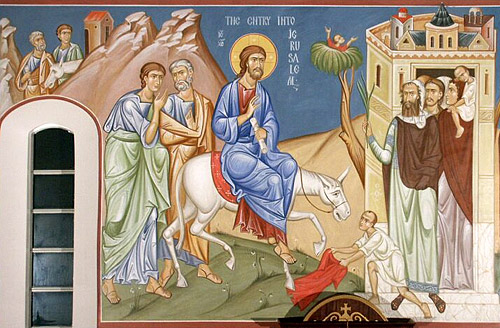
And they that were sent went their way, and found even as he had said unto them. And as they were loosing the colt, the owners thereof said unto them, Why loose ye the colt? And they said, The Lord hath need of him. And they brought him to Jesus: and they cast their garments upon the colt, and they set Jesus thereon. And as he went, they spread their clothes in the way. And when he was come nigh, even now at the descent of the mount of Olives, the whole multitude of the disciples began to rejoice and praise God with a loud voice for all the mighty works that they had seen; saying, Blessed be the King that cometh in the name of the Lord: peace in heaven, and glory in the highest.
And some of the Pharisees from among the multitude said unto him, Master, rebuke thy disciples. And he answered and said unto them, I tell you that, if these should hold their peace, the stones would immediately cry out. saying, If thou hadst known, even thou, at least in this thy day, the things which belong unto thy peace! but now they are hid from thine eyes. For the days shall come upon thee, that thine enemies shall cast a trench about thee, and compass thee round, and keep thee in on every side, and shall lay thee even with the ground, and thy children within thee; and they shall not leave in thee one stone upon another; because thou knewest not the time of thy visitation.And when he was come near, he beheld the city, and wept over it,
And he went into the temple, and began to cast out them that sold therein, and them that bought; saying unto them, It is written, My house is the house of prayer: but ye have made it a den of thieves. And he taught daily in the temple. But the chief priests and the scribes and the chief of the people sought to destroy him, and could not find what they might do: for all the people were very attentive to hear him (Lk. 19:28–48).
This is the description of an historical event that took place twenty centuries ago, as related by an eyewitness. But this event has more than historical significance; it also has a spiritual meaning, and therefore also a moral meaning for every modern-day Christian. According to the spiritual meaning, Jerusalem signifies the human soul, and the entry of the Lord into Jerusalem signifies the entrance of God into the soul.
The multitudes of people, crowded and pushing one against another, joyfully awaiting and greeting Christ, symbolize the noble sentiments and exalted thoughts of a person who joyfully greets God, his Savior and Deliverer. The leaders of the crowd of people, who hate Christ and want to kill Him, personify the lower desires and earthbound thoughts, which take the upper hand over man’s noble nature and oppress it. Now this lower human nature rebels against God’s entry into the soul, for when God is enthroned there, the lower nature will inevitably be destroyed.
The Temple in Jerusalem symbolizes the holy of holies of the human soul—that sacred place where the Holy Spirit has if only a miniscule haven even in the greatest sinner. But earthly passions penetrate there also, and lower human nature has used even it to achieve its base aims.
Christ heals the soul of those sick ones who fall down before Him with faith, and this means that certain impulses of the soul, although sick, thirst for unity with God and seek for Him, the only true Doctor in the world. Christ’s prophecy of Jerusalem’s destruction symbolizes the destruction of any soul that God rejects, lays low, and spews forth from Himself.
No one in this world is happy unless he has opened wide the gates of his spiritual Jerusalem—his soul—and received God into himself. A godless man feels lonely to despair. The society of others does not make his loneliness go away, but only increases it. However he who has taken God into his soul will never feel lonely even in a desert. No one dies an eternal death other than one in whom God has died.
ON PALM SUNDAY
Archpriest Andrew Phillips
In the Name of the Father and of the Son and of the Holy Spirit.
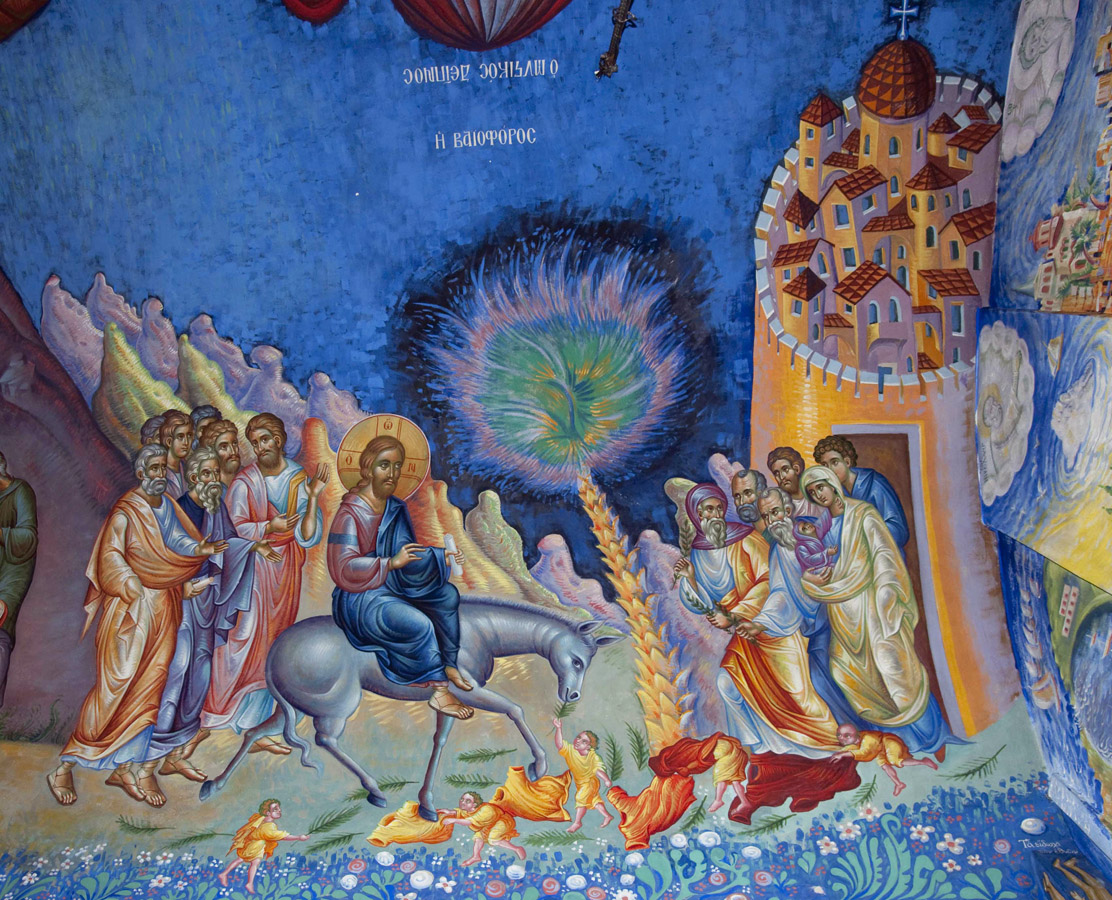
Today the Maker of the Universe enters Jerusalem. He is seated not on a white stallion with a 100,000 strong army to escort Him like the King of Babylon. He is seated on a young ass, the lowest of creatures, and escorted by street children like the King of Jerusalem. For He is not the King of Babylon, the King of War and Power and Pride and Riches, He is the King of Jerusalem, the King of Peace and Humility. And this is only right, for the name 'Jerusalem' means 'the City of Peace'; Christ alone, the King of Peace, is therefore its rightful King.
Children greet Him with palms, the symbols of victory, and they cry 'Hosanna', meaning 'Save, we pray'. Their cry and their deed are greater than they know, for in their innocence they speak and do truth, for Christ alone saves us, if we pray to Him; and the palm branches are indeed tokens of victory, for Victory comes through the Tree of the Cross.
This is not just an historic event, but an event that can be repeated at every communion. For whenever we seek peace and humility as if seated on an ass, as innocent as children crying 'Save, we pray', then Christ enters our souls and makes them into Jerusalems within us.
However, we know that in Jerusalem there were not only children, 'babes and sucklings', who greeted Him, there were also others, Scribes and Pharisees who, as the Gospels say, 'were displeased'. They are those who wanted a worldly leader, a man of violence, a rival to the Romans, and they will lead Christ to Golgotha, preferring an unrepentant thief to the Son of God. Within a few days our Lord will suffer, because He is innocent and all the innocent suffering of the world, of which we have seen so much in our own days, is taken up in Him.
The division between, on the one hand, babes and sucklings and, on the other hand, the worldly Scribes and Pharisees is a division which is repeated through time and space, and all of us have at some time or another been on both sides. For whenever we sin we are on the side of the Scribes and Pharisees, and whenever we are innocent, we are on the side of the babes and sucklings. But whose side are we on today and whose side will we be on this coming week?
For in this coming Great and Holy Week, Passion Week, the Church calls us to follow Christ. On Monday, Tuesday and Wednesday, we begin to relive the dramatic events in Jerusalem of this Week. On Thursday morning we come to the celebration of the Last Supper, which was and is the First Liturgy. On Thursday evening we have the beautiful Service of the Twelve Gospels when the Church tell us all the details of Christ's betrayal, of Judas, of Christ's trial, of Pilate, of Christ's scourging and Crucifixion. On Friday afternoon Christ is taken down from the Cross and on Friday evening He is buried and we shall sing together the Lamentations around His Tomb. On Saturday morning, we shall witness the first Resurrection Liturgy with the changing of vestments from violet into white and then on Saturday at midnight Christ will make clear His Resurrection. This by tradition is the moment when Christ returns to earth and we feel His presence amongst us most clearly.
How can we not come to these services and yet still call ourselves Orthodox? How can we not follow Christ through all the events of this Great Week which changed the history of the whole world? Let us be as babes and sucklings, let us put away our worldly calculations and free ourselves from our laziness, let us be with the family of God, with the Mother of God and St John, and follow Christ to the Cross, so that then we can follow Him to His Resurrection, to Victory and Triumph, and so be resurrected in spirit together with Him.
Amen.