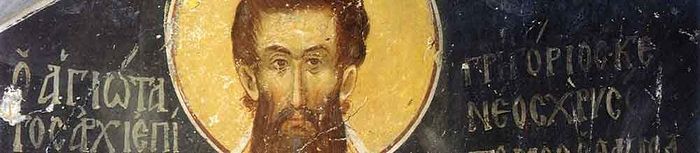
St. Gregory Palamas (1296-1359), archbishop of Thessaloniki (1347-1359), was and is a controversial figure. His experience and teachings of the Uncreated energies of God was severely attacked by Barlaam the Calabrian (who accused him of following the supposedly innovative teachings of St. Nicephorus of Mt. Athos [d. c. 1300]),[1] Gregory Akindynos, Nicephoras Gregoras, and others in his own time. Although his theology was vindicated by several councils in Constantinople between 1341 and 1351, and he was canonized just nine years after his death in 1368, it remained a topic of disagreement. His theology and influence fell into nigh-obscurity from the late sixteenth century practically until the twentieth century, and today there is still disagreement within the Orthodox Church over how to understand his theology and interactions with his opponents, as well as continued debate from outside the Church.[2]

Showing posts with label St. Gregory Palama. Show all posts
Showing posts with label St. Gregory Palama. Show all posts
Monday, 28 March 2016

Monday, 9 March 2015
ST. GREGORY PALAMAS AND THE TRADITION OF THE FATHERS
 Archpriest George Florovsky
"Following the Holy Fathers" ... It was usual in the Ancient Church to introduce doctrinal statements by phrases like this. The Decree of Chalcedon opens precisely with these very words. The Seventh Ecumenical Council introduces its decision concerning the Holy Icons in a more elaborate way: "Following the Divinely inspired teaching of the Holy Fathers and the Tradition of the Catholic Church." The didaskalia of the Fathers is the formal and normative term of reference.
Sunday, 8 March 2015
Saint Gregory Palamas and the Hesychasts (2nd Sunday in Lent)
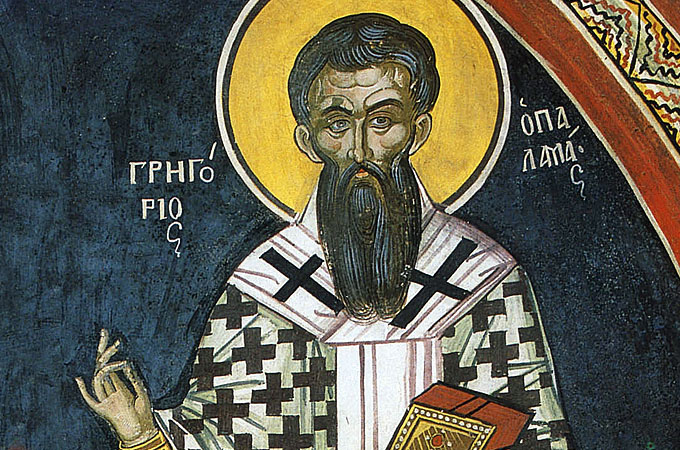
The second Sunday in Lent is devoted to Saint Gregory Palamas (14th century), a hesychast from the Holy Mountain and later Archbishop of Thessaloniki.
Saint Gregory Palamas defended the hesychasts of the Holy Mountain who were being mocked and attacked by the person who expressed the spirit of the Western Church, the monk Barlaam, from Calabria in Southern Italy. When Saint Gregory defended these monks, he set out the Orthodox faith regarding God, the way we can approach Him and what it is that constitutes the salvation of humankind.
Wednesday, 11 February 2015
The Hagioritic Tome

The clearest short statement of the teachings of St Gregory Palamas and the Hesychasts can be found in "The Declaration of the Holy Mountain in Defence of Those who Devoutly Practise a life of Stillness," otherwise known as the "Hagiortic Tome." An English translation can be found in the fourth volume of thePhilokalia, pp. 418-425.
St Gregory Palamas wrote the Declaration in 1340 during the latter stage of his dispute with Barlaam, though the Calabrian is nowhere mentioned by name. The issues raised in the Declaration should therefore be considered in the light of St Gregory Palamas' ongoing dispute with Barlaam, though it should be noted that there is no mention of their earlier disagreement concerning the use of apodictic reasoning as a theological method, as was raised in their exchange on the Latin teaching on the procession of the Holy Spirit. Nor is there any mention of somatopsychic practice, though the role of the body in prayer is emphasized. It appears their earlier disputes over these issues were not of sufficient importance to necessitate a conciliar, doctrinal refutation. Rather, the Declaration focuses on the Hesychasts' claim of the reality of man's participation in God's uncreated, deifying energies.
Saturday, 8 February 2014
Discourse on the Publican and the Pharisee
 St. Gregory Palamas
1. THE unseen patron of evil is full of evil ingenuity. Right at the beginning he can drag away, by means of hopelessness and lack of faith, the foundations of virtue already laid in the soul. Again, by means of indifference and laziness, he can make an attempt on the walls of virtue’s house just when they are being built up. Or he can bring down the roof of good works after its construction, by means of pride and madness. But stand firm, do not he alarmed, for a diligent man is even more ingenious in good things, and virtue has superior forces to deploy against evil. It has at its disposal supplies and support in battle from Him Who is all-powerful, Who in His goodness strengthens all lovers of virtue. So not only can virtue remain unshaken by the various wicked devices prepared by the enemy, but it can also lift up and restore those fallen into the depths of evil, and easily lead them to God by repentance and humility.
Sunday, 21 April 2013
HOMILY SIX - TO ENCOURAGE FASTING
INCLUDING A BRIEF WORD ON THE ORIGIN OF THE WORLD
THE INVISIBLE SERPENT, the originator of evil, is inventive, versatile and extremely skillful in contriving wickedness. He has means to hinder our good purposes and actions as soon as they begin. But if he fails to prevent them initially, he sets up other devices by which he can render them useless once they are underway. If he is unable to make them worthless when they are half way to completion, he knows other tricks and ways to invalidate them even once they are finished, and makes them a source not of reward but of harm to all but the most careful. First of all he points out how laborious and difficult to accomplish virtue is. In this way he fills us with laziness and despair, as though we were attempting difficult and impossible things and were therefore incapable of putting our intentions into action. Then he engenders disbelief in the rewards which God has promised to those who struggle.
Homily Seven - Another On Fasting
THE CALM SEA, RADIANT AND BRIGHT with sparkling light, reflecting the dawn on its smooth surface, is a pleasant sight to the eyes. But it is far more delightful not just to see but to address the church gathered together according to God's will, freed from disturbances, illuminated mysteriously by the divine light, stirred up towards that light's dawn, with hands and eyes, all the senses and the mind uplifted. The grace of the Spirit has today granted me this agreeable sight. You are all spending your nights and days together here in God's temple, and by your unceasing attendance upon Him you could be regarded as heavenly trees planted by the streams of the water of the Spirit. So may I now assist these streams as far as I am able. As you have offered your daytime prayers in addition to your early morning prayers, may we, as far as time allows, offer an evening sermon in addition to the one this morning, that we might show you openly all the different kinds of tricks to which the enemy of our salvation turns his hand to render not only our fasting but also our prayer worthless.
Friday, 12 April 2013
ON FAITH AND CONFESSION

Saint Gregory Palamas
BELIEVING IN GOD IS DIFFERENT from believing God. To believe God is to regard His promises to us as sure and true, but to believe in Him is to have a right understanding of Him. Both are necessary for us and we must speak correctly in both respects, in such a way that people with correct understanding can be confident that we are faithful before the God to Whom our faith is directed and that, being faithful, we shall be justified by Him. “Abraham believed God”, it says, “and it was counted unto Him for righteousness” (Rom. 4:3, Gen. 15:6, cf. Gal. 3:6, Jas. 2:23). Why was Abraham counted as righteous because he believed? He had received a promise from God that in his seed, that is, in Isaac, all the tribes of Israel would be blessed (Gen. 17:16; cf. 26:3-5, 24). Then he was commanded by God to sacrifice Isaac (Gen. 22:1), through whom alone the promise could be fulfilled (Gen. 17:21; 21:12), while he was still a child. “Without contradicting he, the father, was hastening on his way to become his son’s murderer while at the same time regarding the promise concerning his son as infallibly sure (Gen. 22:1-18).
Wednesday, 3 April 2013
The Pure in Heart Shall See God: On St. Gregory Palamas
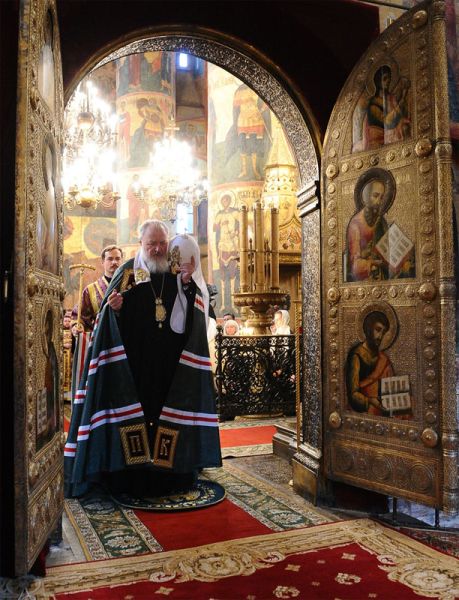
 Patriarch Kirill of Moscow and All Russia
In the Name of the Father, and of the Son, and of the Holy Spirit!
On the second Sunday of Great Lent the memory of St. Gregory Palamas, Archbishop of Thessalonica, is celebrated. Archbishop Gregory was an enlightened man and a remarkable theologian who had experience of the monastic life on Mount Athos. In the distant fourteenth century he distinguished himself as an especially penetrating spiritual thinker. In his works he defended the Divine Light of Tabor, asserting that the light Christ manifest to the disciples on Tabor was not an ordinary light, as some thought, but a visible manifestation of Divine energy, of Divine grace.
Repentance According to Saint Gregory Palamas
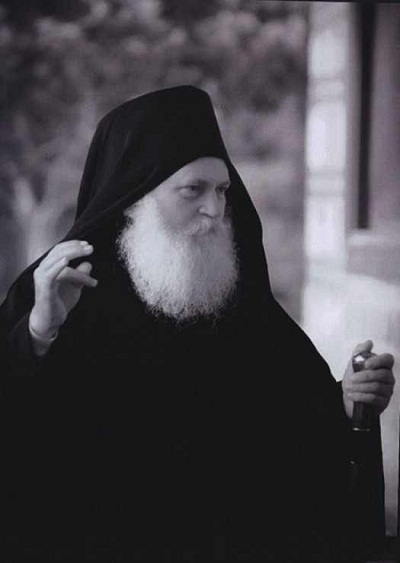
Abbot Ephraim of Vatopedi
As we all know, Saint Gregory Palamas is a great luminary of the Orthodox Church, who with the whole of his theology- the fruit of his life in Christ- managed, in his day, to revive Orthodox theology in all its profundity. It is said on the Holy Mountain that Saint Gregory Palamas’ theology covered all the gaps from the past and the future.
The Athonite saint began his life on the Mountain at the monastery of his “repentance”, i.e. where he was tonsured, the Great Monastery of Vatopaidi, being taught the tasks of the spirit and the ascetic life by Saint Nikodimos the Hesychast the Vatopaidan. Illumined by the uncreated energies of the Holy Spirit, Saint Gregory acquired spiritual wisdom and became an outstanding teacher of the virtues and of the life according to God.
From the Post-Modern Persona to the Person
A study on the anthropology of Saint Gregory Palamas
 Elder Efraim of Vatopaidi
Sunday, 31 March 2013
The Second Sunday Of Lent: The Sunday Of Saint Gregory Palamas
Introduction
On the Second Sunday of Lent the Orthodox Church commemorates our Holy Father Gregory Palamas, Archbishop of Thessalonica, the Wonderworker. The feast day of Saint Gregory Palamas is November 14, however, he is commemorated on this Sunday as the condemnation of his enemies and the vindication of his teachings by the Church in the 14th century was acclaimed as a second triumph of Orthodoxy.
Life Of The Saint
 |
| Icon of Saint Gregory Palamas provided by Theologic and used with permission. |
Our holy Father Gregory was born in Constantinople in 1296 of aristocratic parents who had emigrated from Asia Minor in the face of the Turkish invasion, and were attached to the court of the pious Emperor Andronicus II Palaeologus (1282-1328). Despite his official duties, Gregory's father led a life of fervent prayer. Sometimes as he sat in the Senate, he would be so deep in prayer as to be unaware of the Emperor addressing him. While Gregory was still young, his father died after being clothed in the monastic habit; and his mother for her part wanted to take the veil, but delayed doing so in order to take care of the education of her seven children. Gregory, the eldest, was instructed by the most highly reputed masters of secular learning and, after some years, was so proficient in philosophical reasoning that, on listening to him, his master could believe he was hearing Aristotle himself. Notwithstanding these intellectual successes, the young man's real interest lay only with the things of God. He associated with monks of renown in the city and found a spiritual father in Theoleptus of Philadelphia, who instructed him in the way of holy sobriety and of prayer of the heart.
Gregory Palamas: An Historical Overview
Written by M.C. Steenberg.
An overview of the historical circumstances of St Gregory's life and theological engagement, including a survey of the theological landscape that provided the contours of his own theological interactions.
Gregory Palamas Knowledge, Prayer and Vision
A study of three foundational aspects of the theology of St Gregory Palamas.
Three foundational aspects of the Theology of St Gregory Palamas
The theology of St Gregory Palamas, as expressed during the Palamite Controversy of the mid-14th century, is far too extensive to be addressed in its full breadth in a paper such as this. Rather than attempt a manifestly impossible task, then, we will limit the focus of this essay to three central points in that theology: first, the idea of knowledge as expressed in the conflict between Gregory and Barlaam; second, the matter of prayer and the body; and third, the notion of the divine vision, which will lead naturally into a discussion of the energies and the essence of God.
Sunday of St Gregory Palamas

Lenten Synaxarion
Now is the truly great preacher of the Radiant Light
Led by the Source of Light to the never-setting Light
This son of the divine and never-setting Light was a true man of God indeed, and a wondrous servant and minister of the divine mysteries, having been born in the imperial city (Constantinople) of most radiant and glorious parents. Through his virtue and instruction he desired to adorn not only the outer of mankind according to the senses, but also much of the unseen inner being. When he was yet quite young, his father died. His mother, brothers and sisters raised him and instructed him in morals, catechism and sacred scripture, and sent him to teachers of worldly wisdom, from whom he learned well. Cleverly combining his learning with a natural zeal, he soon became skilled in verbal arts. At the age of twenty, regarding all earthly things as inferior and passing dreams, he sought recourse to God the Author and Giver of all wisdom, to consecrate his entire self to God through a perfect life. Hence he disclosed his great love for God, his pious intentions and burning desire to his mother, and he found that for a long she too had been desirous of this and rejoiced at his decision. And straightway gathering her children his mother said with joy, 'Behold, I and the children God has given me!' And she disclosed to them the intent of the great Gregory, asking if it seemed to them to be good. And he with words of instruction soon convinced them all in earnestness to follow him in his love and withdrawal from life. Distributing then his earthly possessions to the poor according to the teachings of the Gospel, and cheerfully abandoning human love, earthly honor and the approbation of men, he followed after Christ.
GOD IS LIGHT

SECOND SUNDAY OF GREAT LENT
ST. GREGORY PALAMAS
Commemorated November 14/27, and on the Second Sunday of Great Lent
St. Gregory Palamas, one of the pillars of Orthodoxy, was born in 1296, probably to a noble Anatolian family in Constantinople. He and his brother went to Mount Athos in around 1318, and lived in Vatopedi and Esphigmenou Monasteries. Gregory also successfully persuaded his widowed mother, brothers and sisters to become take up the monastic life. With the encroachment of the Turks, he was forced to flee to Thessalonica, being ordained a priest there in 1326. Afterward, he took up the eremetic life at a mountain near Beroea, and eventually returned to Athos in 1331.
Subscribe to:
Comments (Atom)