Showing posts with label St. John (Climacus) Of Sinai. Show all posts

Saturday, 16 April 2016

Sunday of St. John of the Ladder

Metropolitan Anthony of Sourozh

In the Name of the Father, the Son and the Holy Spirit.

Lent is a time of repentance, a time when our heart of stone must be made by the power of God into a heart of flesh, from insensitive to perceptive, from cold and hard to warm and open to others—and indeed, to God Himself.

Monday, 31 March 2014

St John Climacus and the Ladder of Divine Ascent

by Blessed  Metropolitan  Philaret
Sunday Four in Great Lent

In the name of the Father, and of the Son, and of the Holy Spirit.

More than once, brethren, the fact has been mentioned that on each Sunday in the Great Fast (i.e., Lent) there are other commemorations besides that of the Resurrection. Thus, on this day, the Church glorifies the righteous John of the Ladder, one of the greatest ascetics, which the Church, in speaking of them, calls "earthly angels and Heavenly men."

Wednesday, 17 April 2013

St John Climacus and the Ladder of Divine Ascent

by Blessed  Metropolitan  Philaret
Sunday Four in Great Lent

In the name of the Father, and of the Son, and of the Holy Spirit.

More than once, brethren, the fact has been mentioned that on each Sunday in the Great Fast (i.e., Lent) there are other commemorations besides that of the Resurrection. Thus, on this day, the Church glorifies the righteous John of the Ladder, one of the greatest ascetics, which the Church, in speaking of them, calls "earthly angels and Heavenly men."

Monday, 15 April 2013

I Am Climbing St. John’s Ladder

5551485217_8ffd5237e8_o
Archpriest John Moses
Apr 15th, 2013

I have come to the conviction that God is pleased with me.

This might seem like a ridiculous idea for those who know me. Spend a little bit of time with me and you will find me to be a foolish, silly old man who really ought to be farther along in his spiritual life than he is. After all, I’ve been a Christian since my youth, so how is it possible that I am still such a foolish, sinful, and silly old man?

Most Sundays, someone will say to me that they are ashamed because when they come to confession, they seem to confess the same sins week after week. They wonder if it will ever change. Because of persistent sins, despondency sets in. They will say, “It seems like I take one step forward and two steps back. Surely God is tired of me and very displeased with me.” Oh, I understand how they feel. At times, I hear the same voice: “you can’t get a leopard to change his spots.” In my case, it might be more appropriate to say: “you can’t teach an old dog new tricks.”

The Ladder of Divine Ascent: Lesson 1


John Climacus: On Repentance That Leads to Joy

Written by M.C. Steenberg.

A study of the spirituality of St John of the Ladder, with particular emphasis on the relationship of repentance and joy in the spiritual struggle.
The Spirituality of St John Klimakos
Those who aim at ascending with the body to Heaven, indeed need violence and constant suffering, especially in the early stages of their renunciation, until our pleasure-loving dispositions and unfeeling hearts attain to love of God and chastity by manifest sorrow.[1]
St John begins forthrightly in his Ladder. He is neither flowery with his words nor soft in his speech, but instead speaks simply and with a driving intent. There is a certain ‘brutal honesty’ to his spiritual direction, for he does not make any attempt to portray the path of salvation and sanctification in a way that will be pleasing to men, but rather in a manner that is truthful to the reality of God. It is not every Father who would begin his 30-step manual for spiritual growth with the daunting ‘Renunciation of the World.’

Introduction

On March 30 and on the Fourth Sunday of Holy Lent the Orthodox Church commemorates our Righteous Father John Climacus. He is called Climacus due to his authorship of the great spiritual work The Ladder of Divine Ascent. His commemoration is designated by the Church on one of the Sundays of Lent as his life and writings affirm him as a supreme bearer and proponent of Christian asceticism. The ascetic example of this great Saint of the Church inspires us in our Lenten journey.

Life Of The Saint

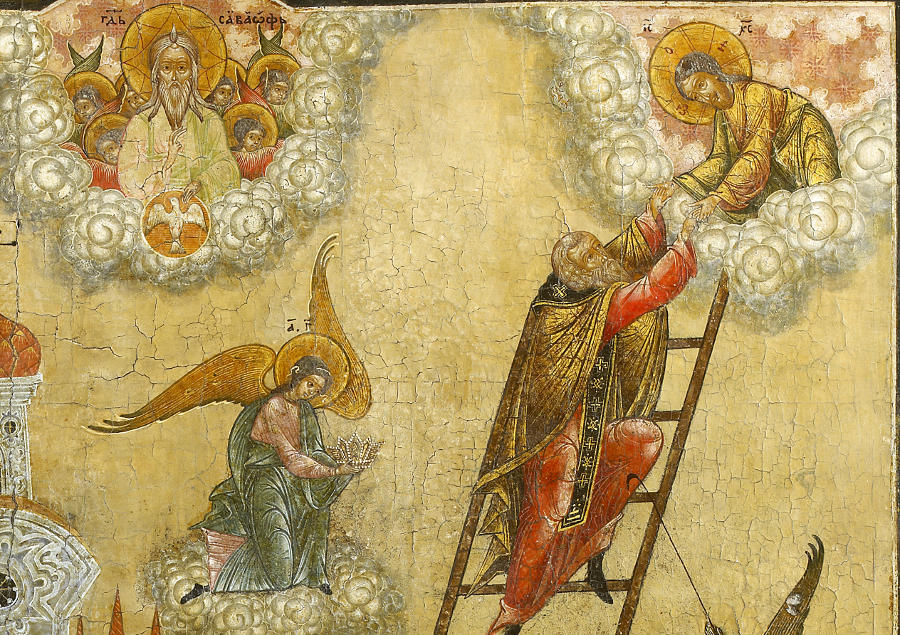
Icon of Saint John Climacus and the Ladder of Divine Ascent provided by Athanasios Clark and used with permission.
Saint John Climacus was probably born in the second half of the sixth century; but his country and origins are alike unknown because, from the beginning of his renunciation of the world, he took great care to live as a stranger upon earth. “Exile,” he wrote, “is a separation from everything, in order that one may hold on totally to God.” We only know that, from the age of sixteen, after having received a solid intellectual formation, he renounced all the pleasures of this vain life for love of God and went to Mount Sinai, to the foot of the holy mountain on which God had in former times revealed His glory to Moses, and consecrated himself to the Lord with a burning heart as a sweet-smelling sacrifice.
Setting aside, from the moment of his entry into the stadium, all self-trust and self-satisfaction through unfeigned humility, he submitted body and soul to an elder called Martyrios and set himself, free from all care, to climb that spiritual ladder (klimax) at the top of which God stands, and to “add fire each day to fire, fervour to fervour, zeal to zeal.” He saw his shepherd as “the image of Christ” and, convinced that his elder was responsible for him before God, he had only one care: to reject his own will and “with all deliberateness to put aside the capacity to make [his] own judgement,” so that no interval passed between Martyrios’ commands, even those that appeared unjustified, and the obedience of his disciple. In spite of this perfect submission, Martyrios kept him as a novice for four years and only tonsured him when he was twenty, after having tested his humility. Strategios, one of the monks present at the tonsure predicted that the new monk would one day become one of the great lights of the world. When, later, Martyrios and his disciple paid a visit to John the Savaite, one of the most famous ascetics of the time, the latter, ignoring the elder, poured water over John’s feet. After they had left, John the Savaite declared that he did not know the young monk but, under the inspiration of the Holy Spirit, he had washed the feet of the Abbot of Sinai. The same prophecy was confirmed by the great Anastasios the Sinaite (April 21), whom they also went to visit.

The Fourth Sunday of Great Lent

S. V. Bulgakov, Handbook 

In the Church services for the fourth Sunday the Holy Church offers us a great example of the life of fasting in the person of the Venerable John of the Ladder (see page 106), who, "having overcome the flesh through fasting" and "by the sweat of his ascetic efforts quenched the fiery arrows of the enemy" and "renewed the strength of souls " and, "ascending to the height of virtues", "received in his soul the divine wealth of the Spirit, undefiled prayer, chastity, modesty, continuous vigil", "was deified through heavenly glory", "was revealed as a physician to those sick through sin" and was the author of "The Ladder of Paradise". According to the expression of the Holy Church, how the profoundly granted ascetic life of the Venerable John "gives us a pleasure sweeter than honey", and so his "Ladder" "brings to us the ever flowering fruits of his teaching, pleasing the heart with vigilant heeding: for souls are rising up the ladder from earth to heaven and abiding in glory". Approving fasting with the example of the Venerable John, the Holy Church offers us a new consolation in the Gospel and Epistle readings of this Sunday. In the first she shows that fasting and prayer defeats the very spiritual enemy of the salvation of man, and predicted this victory in the circumstances of suffering, the death and the resurrection of Christ; and in the second she reminds us of the inalterability of God's will for the salvation of man, in order that we have a firm hope.

 OF THE LADDER (CLIMACUS)

St. John Climacus
St. John Climacus
St. John Climacus is honored by the Church as a great ascetic and as the author of a remarkable work entitled, The Ladder of Divine Ascent, and therefore he has been named “Climacus,” or “of the Ladder.”
There has been very little information preserved about his origin. Tradition tells us that he was born in around the year 570, and was the son of Sts. Xenophon and Maria, who are commemorated on January 26/February 28. St. John came to the monastery on Mt. Sinai at age sixteen. Abba Martyrius became his spiritual father and mentor. After four years of living on Mt. Sinai, John was tonsured a monk. One of the fathers present at his tonsure foretold that John would become a great luminary of Christ's Church. St. John labored in asceticism for nineteen years in obedience to his spiritual father. After the death of Abba Martyrius, St. John chose the life of reclusion, departing to a desert place called Thola, where he lived forty years in silence, fasting, prayer, and repentant tears. It is not by chance that St. John speaks so much of repentant tears in The Ladder. "As fire burns and destroys dead wood, so do pure tears cleanse all impurity, both inwardly and outwardly." His prayer was strong and effective—this can be seen in the following example of the great ascetic's life.
Uncovering Our True Humanity: On the Sunday of St. John Climacus
Archpriest Vsevolod Shpiller (+1984)

And one of the multitude answered and said, Master, I have brought unto Thee my son, which hath a dumb spirit: and wheresoever he taketh him, he teareth him, and he foameth, and gnasheth with his teeth, and pineth away: and I spoke to Thy disciples that they should cast him out, and they could not. He answereth him, and saith, O faithless generation, how long shall I be with you? how long shall I suffer you? Bring him unto Me. And they brought him unto Him: and when he saw Him, straightway the spirit tore him, and he fell on the ground, and wallowed foaming. And He asked his father, How long is it ago since this came unto him? And he said, Of a child. And ofttimes it hath cast him into the fire, and into the waters, to destroy him: but if Thou canst do anything, have compassion on us, and help us. Jesus said unto him, If thou canst believe, all things are possible to him that believeth. And straightway the father of the child cried out, and said with tears, Lord, I believe, help Thou my unbelief. When Jesus saw that the people came running together, He rebuked the foul spirit, saying unto him, Thou dumb and deaf spirit, I charge thee, come out of him, and enter no more into him. And the spirit cried, and rent him sore, and came out of him, and he was as one dead, insomuch that many said, He is dead. But Jesus took him by the hand, and lifted him up, and he arose. And when He was come into the house, His disciples asked Him privately, Why could not we cast him out? And He said unto them, This kind can come forth by nothing, but by prayer and fasting (Mark 9:17-31). 

Thursday, 11 April 2013


The Fourth Week of Great Lent
S. V. Bulgakov, Handbook for Church Servers
Преподобный Иоанн Лествичник
"This is a holy week of light, in which the precious Cross is exalted in the sight of all the world". During all this week up to Saturday "sanctifying the time of abstinence the divine and precious Cross" in the midst of the temple "clearly offers everything, source of divine forgiveness, both light of heaven and life and true joyfulness", "bestowing on those who venerate it redemptive sanctification, light and glory and mercy" and "facilitating the season of the Fast for us".[1] Representing beneficial fruits sprouting from the life-creating tree of the Cross into a sinful world, the Holy Church sings praises to the Holy Cross, as "a tree of life, the spoiler of Hades, the joy of the world and the consumer of corruption", "the sceptre of the Holy Messiah, the heavenly glory of man, the praise of kings, the dominion of faith, the invincible weapon, the driving away of enemies, the light of radiance, the salvation of the world, the great glory of martyrs, the power of the righteous, the brightness of angels", "the sign of joy, the praise of martyrs, the adornment of apostles, the confirmation of bishops", "the joy of the Orthodox, the protector of the universe", "the fortress of abstinence, the cooperator of the vigilant, the strengthening of the fasters, the upholders of the stragglers". Praising the Holy Cross, the Holy Church together with it calls on its children to restrain "from corrupting passions for food by abstinence and from sweets by disgust", and "purifying themselves by fasting" to venerate the Holy Cross "with awe and by faith", "drawing up sanctification for their souls". But as success in the Lenten spiritual efforts may, especially after having already achieved the mid-point of the holy Forty Day Fast be eclipsed by gluttony, the Holy Church following the example of the Lord, who humbled Himself by dying on the cross, also calls us to humility, so that we may not lose our justification before God because of Pharisaic pride, looking not only at our deeds, but also in our thoughts.