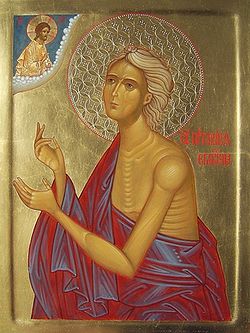
Showing posts with label St. Mary of Egypt. Show all posts

Sunday, 2 April 2017

The Mystery of the Desert


  Православие.Ru, 2 апреля 2017 г. 
http://www.pravoslavie.ru/english/102363.htm

Reader Dimitry Tribushny

The Life of St. Mary of Egypt is one of the ascetical treasures of the Orthodox Church, which helps us understand God’s plan for salvation. Like everything that is outside of time, the Life of the Egyptian desert-dweller is contemporary in the true sense of the word—every living soul can recognize its own experience in St. Mary’s experience; the Life of the saint both rebukes and heals.

*   *   *

St. Mary crosses the Jordan.

According to the [Russian] Bible dictionary, believing means not only, and not so much being sure of something as it means trusting. It means being ready to follow the One Whom you love, with open eyes. To go where He Himself leads you. To the desert. Thus did Abraham leave his house in order to learn the Truth, bringing his own son as a sacrifice. Thus was Job led to the desert of total loss, and spoke with the unsearchable God face to face. Thus did the Israelites trust in God and through risky wanderings in the desert they obtained the Promise Land for themselves.

The desert is a place of trust, and not surety. There is no guarantee here. How many of the Israelites who followed Moses actually saw the earthly paradise?

Faith, or belief, is discomfort, pain, light, and joy. Having faith (believing) means walking on water.

*   *   *

Why did the Lord call Mary to repentance in such an unexpected manner? Does this mean that there are on this earth special people chosen by heaven, for whom the path of salvation and illumination are prepared, and that if you don’t belong to their category then there is no point in fleeing your enslavement?

If we suppose that the Creator divided his children from the beginning (not just creatures, but children) into the loved and not loved, then we turn ourselves into marionettes, and the Last Judgment promised in the Gospels is cancelled. The simplest justification for a sinner is, “I was not chosen for salvation, You did not give me the possibility to rise from my knees, so how can I now converse with angels?”

Fatalism says that the Lord gave Mary strength, and therefore the harlot became an angel. First grace, and then labors. But we see it differently. On the earth, time moves from the past to the future, but in heaven there is no past, nor future. Therefore the Lord gives special grace to the one whom His foreknowledge discerns to be a laborer of the spirit. First labors, and then grace. It is a paradox of reverse time.

If a music teacher were clairvoyant and knew how his students would make use of his lessons, he would give more attention to those who truly dedicated themselves to any work and who would in the future “serve the muses.”

First (if we can say it this way) the Lord saw Mary, who lived in the desert like an angel, and only then as a harlot.

First the Lord saw Mary’s martyrdom in the desert, her absolute dedication to the revealed Truth. Only for that reason was she given such grace.

If a person is ready, like Mary, to wither from heat, nearly die from the cold, starve the body, and war to the utmost with the passions, then the Lord reveals His love, strength, and glory to that person.

*   *   *

The word “sin” translated from the Greek means, “missing the mark”. A sinful person is one who directs the God-given strengths of his soul to the wrong aims. Thus, discernment that misses its goal becomes judgment, a sense of one’s own dignity becomes pride, and emotions become anger.

St. Mary of Egypt received from the Lord the gift of fiery, unquenchable love, and instead of giving her heart to her Creator and His creation, she directed all the force of divine eros on herself. But any talent directed exclusively towards our “Me” not only impoverishes a person—it deprives him of his sanity.

“He was out of his mind” is how the Church hymn describes another gifted egotist—the prodigal son.

When Mary finds herself in Jerusalem, her love returns to its natural course. For the sake of love for the Lord the desert-dweller who had sinned inhumanly accepts the podvig of inhuman asceticism and struggles for seventeen years with cold and heat, hunger and demonic thoughts.

*   *   *

The repentance of St. Mary of Egypt.


I don’t know about you, but I believe in the sincerity of Mary’s first repentance; I think that she could have changed her life, gotten married, had children, and become an exemplary Christian. But why does the Lord Whom she trusts lead her to the desert? Weren’t her tears enough? Couldn’t the Lord just forgive her right away? He can. Abba Sisoes was asked the same question: “If a brother falls, is one year of repentance enough for him?” He answered: “Those are cruel words!” “Are six months enough?” he was asked again. “Too many,” the elder answered. They asked again, “Are forty days enough?” “That is also too much,” he answered. “Then how many?” they said. “If a brother falls and a supper of love [the Eucharist.—Trans.] is soon held, can he come to the supper?” “No,” the elder answered,” he must spend several days in repentance. And I believe that if he repents with all his soul, then God will receive him in three days” (Memorable stories about the ascetic labors of the saints and blessed fathers).

The Life emphasizes that repentance is an ontological event, and not one of ethics. The penitent is redeemed, and now he needs healing of his nature and sanctification.

How often does a newly-converted sectarian feel pleased with himself that he has given up fornicating or drinking. For the Orthodox this is only the beginning, the first step. After that, grace allows him to see his own imperfection. The person enters into a fight to the death with his own self, disclosing more and more new passions.

Thus, in a low-lit room everything seems clean, but when the light is turned on the picture is different—the housekeeper notices every speck of dust. If sectarians knew God and had an authentic experience of grace, they would never stop on the path of repentance.

Here is another analogy: Our own imperfection is clearly seen when coming closer to the center. The top musician of St. Louis gets third place in Chicago, fifth in New York, and seventh in Paris. Why would a woman with so many affirmations that she has been forgiven by God (she walks on water, has the gift of clairvoyance, etc.) sincerely consider herself the worst sinner? Because she was approaching the Center, and was illumined by an unutterable light.

*   *   *

The saint leaves the world and there, in the desert, far from the noisy cities and solitary monasteries, she has her first connection with other people. “What is taking place in the empire?” the desert-dweller asks Abba Zosima. Seventeen years ago she was interested only in her body. Now Mary knows that there are other people.

*   *   *

Repentance is an ontological event, and not one of ethics. Therefore in the sacrament of confession of sins not only is the soul transformed, but also the body.

Here is the recollection of one nun, a spiritual daughter of Fr. Ambrose [of Optina], of how she once confessed in the elder’s cell: “In his cell burned votive lamps and a small wax candle on the table. It was too dark for me to read from a list [of sins], and I had no time. I said what I remembered, and that hastily, then added, ‘Batiushka, what else can I say to you? What should I repent about? I’ve forgotten.’ The elder criticized me for that. But suddenly he rose from his bed where he was lying down. Having made three steps, he found himself in the middle of his cell. I involuntarily turned after him on my knees. The elder straightened to his full height, raised his head and hands upward as if in a prayer position. It seemed to me at the time that his feet left the floor. I looked at his illumined head and face. I remember that the ceiling in the cell was as if gone, it parted, and the elder’s head was as if thrust upwards through it. This appeared very clearly to me. A minute later, batiushka leaned over me, astounded at the vision as I was, and making the sign of the cross over me said these words: ‘Remember, this is what repentance can lead to. Now go.’ I left him, staggering, and wept the whole night through about my stupidity and carelessness. In the morning we were given horses and we left. While the elder was still alive I couldn’t tell anyone about this. He forbade me once and for all to talk about such incidents, threatening, ‘Otherwise you will lose my help and grace’” (from the Life of St. Ambrose of Optina).

The repentant sinner not only receives the gift of clairvoyance, but also walks on water.

Believing means walking on water.

Monday, 18 April 2016

REMEMBER SINS AND DESPAIR NOT: A HOMILY ON THE SUNDAY OF ST. MARY OF EGYPT

Jesse Dominick

This Sunday we commemorate the great female ascetic St. Mary of Egypt. There are so many things we can learn from St. Mary. The Church gives her to us during this time of fasting as the supreme example of a life of asceticism. Last Sunday was the Sunday of St. John Climacus whose book The Ladder of Divine Ascent is the supreme ascetical text, and this week we have St. Mary of Egypt who shows us the supreme ascetical life. We even read her entire life during the Great Canon of St. Andrew this past Thursday, so you know that she is incredibly important. There are so many things we can learn from her—but the thing I want to focus on is the remembrance of sins.

Saturday, 16 April 2016

TWO KINDS OF ASCETICISM

The “Standing of St. Mary of Egypt”

Priest Maxim Prikhodko

Our Lenten journey has several important markers, several special liturgical days. One of these remarkable landmarks is the “standing of St. Mary”—the day [in the fifth week of Great Lent] when at the evening service the entire Canon of repentance of St. Andrew of Crete is read, and along with it, the faithful listen to the amazing life of a woman acetic who lived in the late fifth-early sixth century—St. Mary of Egypt.

Friday, 11 April 2014

Saint Mary the Egyptian

Metropolitan Iosif of Prikonisos 

The fifth Sunday of Lent is dedicated to Saint Mary the Egyptian. This Mary is a unique and eternal example of repentance and of rehabilitation and perfection in Christ. As we enter the final straight towards the Spotless Passion, and the Life-Bearing Resurrection of Our Lord, the need for proper preparation through repentance, so that we can experience in a redemptive manner the Cross and Resurrection, becomes ever more urgent and imperative. This is why, on this Sunday, the Church highlights the figure and example of Saint Mary, in order to provide the help we need.

Thursday, 2 May 2013

St. Mary of Egypt and Holy Thursday

[St. Mary of Egypt died on Holy Thursday. Since we have this rare commemoration today of both Holy Thursday and St. Mary of Egypt, it is of special significance that we remember St. Mary of Egypt's last Holy Thursday, recorded below by St. Sophronios. - J.S.]

When Abba Zosimas heard that the holy ascetic [Mary] quoted the Holy Scripture from memory, from the Books of Moses and Job and from the Psalms of David, he then asked the woman, "Mother, have you read the Psalms and other books?"

Sunday, 21 April 2013


The Memory of the Blessed Mary the Egyptian
  Nektarios Thanos

“… her many sins have been remitted, because she loved greatly” Luke 7, 47.

Learning Resolve From St. Mary of Egypt

Archpriest Alexander Iliashenko

Today we celebrate the memory of one of the greatest saints known to the history of the Church: Mary of Egypt. She spent her life not as an ordinary person, but as a highly spiritual one, as an angel in the flesh. Her life was beyond our comprehension: how can someone live for forty-seven years in the desert, perfectly alone and in silence, enduring terrible demonic temptations and the horror of death? The only kind of person who could take on such an ascetic struggle is one who loved Christ with all her being and was prepared to renounce even her natural human needs. And the Lord, beholding this extraordinary resolve, this extraordinary love, granted her everything needful. We do not understand how, spending forty-seven years in the desert, she did not perish from hunger, thirst, or disease. But the Lord strengthened her in this ascetic struggle by His grace-filled power.

5. Sunday Of The Great Lent
S. V. Bulgakov, Handbook
     The church service for this Sunday is devoted to the memory and glorification of the spiritual efforts of Saint Mary of Egypt (See Apr. 1), who "has cut down with the sword of abstinence the desires of your soul and the passions of your flesh. You have choked your sinful thoughts with the silence of the ascetic life, and you have watered all the wilderness with the streams of your tears, and caused the fruits of repentance to spring up for us" and "with works of Lenten fasting", "as the sun she shines revealed as a guide to all who have sinned". 

Saturday, 20 April 2013


THIS IS OUR CHANCE TO BEAR GOOD FRUIT


In turn with the other triumphant, hopeful weeks of Great Lent, today the Holy Church remembers the ascetic struggles of St. Mary of Egypt. Why has the image of this great saint been inserted into this week? Is it because we see the triumph of God’s power and the triumph of truly reciprocated human love? Or, perhaps we see the triumph of the desperate human cry for help, and the victory granted by God, by His love, His power and strength? In a word, we see in it the triumph of repentance.
We’ll tell you a little about her life as she revealed it to the saintly desert-dweller Zosima. She was born in Egypt, and left her parents’ house at age twelve and went to Alexandria, where she began to live a life of sin.
The Fifth Sunday Of Great Lent: 
The Sunday Of Saint Mary Of Egypt

Introduction
On the Fifth Sunday of Lent the Orthodox Church commemorates our Righteous Mother Mary of Egypt. The feast day of Saint Mary of Egypt is April 1, however, she is also commemorated on this Sunday due to her recognition by the Church as a model of repentance.

Life Of The Saint
Our holy mother Mary was born in Egypt. She had left her parents at the age of twelve to go to Alexandria, where she spent the next seventeen years in debauchery and the greatest profligacy. Living on charity and linen-weaving, she nevertheless offered her body to any man, not being forced to it by dire necessity as were so many poor women, but as though she were consumed by the fire of a desire that nothing was able to appease.
Saint Mary of Egypt: A Living Example of the Power of Repentance


By Elder Epiphanios Theodoropoulos
Sermon for the Sunday of St. Mary of Egypt


by Metropolitan Anthony Sourozh
Why Is St. Mary of Egypt Remembered During Lent?

Each of the Sundays of Great Lent has its own special theme in the Orthodox Church. The First Sunday of Great Lent we celebrate the "Sunday of the Triumph of Orthodoxy" since it was on this day in 843 A.D. that the final great heresy against the person of Christ, that of Iconoclasm, was eradicated and the Orthodox Faith became the standard by which mankind could achieve purification, illumination and glorification. The Second Sunday of Great Lent is dedicated to St. Gregory Palamas and serves as another triumph of the Orthodox Faith, this time against the heresy of Barlaam the Calabrian who taught that mankind cannot partake of glorification in this life.
Sermon for the Fifth Sunday of Great Lent


CATECHESIS 68: That We Must Be Renewed For What Is Ahead Through Endurance of the Trials That Fall Upon Us, Both Visible and Invisible. 

by St. Theodore the Studite
21 Interesting Facts About St. Mary of Egypt
By John Sanidopoulos
Venerable Mary the Egyptian

(Feast Day - April 1)

By St. Nikolai Velimirovich


Synaxarion For the Fifth Sunday of Great Lent

Thursday, 18 April 2013

REJOICE, THE SEXUALLY IMMORAL PENITENTS 


Archpriest Andrei Tkachev


Venerable Mary of Egypt
     Characteristics of the "world" in the mouth of Jesus Christ capacious and brief. "Whoever is ashamed of me and of my words in thisadulterous and sinful generation, the Son of Man will be ashamed of ..." (Mark 8:38)
     Two words: "adulterous and sinful." Although adultery is a sin, you can not, obviously, just say "sinful." Have yet to identify adultery in a separate category because it is - sin ruling. And the Lord did not say, "In this generation, furtively, hypocritical, self-serving, sanctimonious, ill," and so on and so forth. All of this list is not necessary, but the adultery - it is necessary. "In this adulterous and sinful."
     On the Lot and Sodom said that he was "living among them (Sodom), daily vexed his righteous soul, seeing and hearing their lawless deeds" (2 Pet. 2:8) While still called the "righteous" who after fleeing the sinking of the father of his own grandchildren because of drunk slept with his daughters. It is said that the Lord "righteous Lot, distressed by the people wicked:" (2 Pet. 2:7)

Wednesday, 17 April 2013

THURSDAY OF THE GREAT CANON, WITH THE LIFE OF ST. MARY OF EGYPT

Fifth Week of Great Lent

Know that you have sinned and you will atone for your sins.—St. Nilus of Sinai

On Wednesday evening a very special service is celebrated in Orthodox churches—the Great Canon with the Life of St. Mary of Egypt. This is the only time in the year when the Great Canon of St. Andrew of Crete, which was read in four parts during the first week of Great Lent, is read in its entirety, along with the canon to St. Mary of Egypt. This canon contains every motivation toward fasting and repentance, and the Church repeats it in the fifth week in its entirety in order to inspire us with renewed strength to finish the course of the fast. The Life of St. Mary of Egypt is also read to that end—to motivate us to be attentive and repent.
During the Matins service for Thursday (read on Wednesday evening), the first half of the Life of St. Mary of Egypt is read following sessional hymns after the kathisma (Psalter reading). Then we read Pslam 50, and begin the Great Canon. The second part of the Life of St. Mary is read after the third ode of the Canon.

*   *   *

The Life of St. Mary of Egypt
by St. Sophronius, Patriarch of Jerusalem

St. Zosima and St. Mary of Egypt. From the iconostasis of the side-church of St. Mary of Egypt, Sretensky Monastery, Moscow
"It is good to hide the secret of a king, but it is glorious to reveal and preach the works of God." (Tobit 12:7) So said the Archangel Raphael to Tobit when he performed the wonderful healing of his blindness. Actually, not to keep the secret of a king is perilous and a terrible risk, but to be silent about the works of God is a great loss for the soul. And I (says St. Sophronios), in writing the life of St. Mary of Egypt, am afraid to hide the works of God by silence. Remembering the misfortune threatened to the servant who hid his God-given talent in the earth (Mat. 25:18-25), I am bound to pass on the holy account that has reached me. And let no one think (continues St. Sophronios) that I have had the audacity to write untruth or doubt this great marvel --may I never lie about holy things! If there do happen to be people who, after reading this record, do not believe it, may the Lord have mercy on them because, reflecting on the weakness of human nature, they consider impossible these wonderful things accomplished by holy people.

Monday, 15 April 2013

St. Mary Of Egypt

Music by Arvo Part - Sanctus from Berliner Mass

Troparion (Tone 8)

The image of God was truly preserved in you, O mother
For you took up the Cross and followed Christ.
By so doing, you taught us to disregard the flesh, for it passes away;
But to care instead for the soul, since it is immortal.
Therefore your spirit, O holy Mother Mary, rejoices with the Angels.


Kontakion (Tone 3)

Having been a sinful woman,
You became through repentance a Bride of Christ
Having attained angelic life,
You defeated demons with the weapon of the Cross;
Therefore, O most glorious Mary you are a Bride of the Kingdom!