Showing posts with label 12. Holy and Great Friday. Show all posts

Sunday, 18 February 2018

These holy days we do not just commemorate the Passion of the Lord, but through the grace that the Church has bestowed upon us during Great Lent, we become contemporaries of His Passion.
The Lord is the Lamb of God ‘slain from the foundation of the world’. He is continually slain for us unto the end of the ages, so that we, His enemies, might enjoy unending delight in the Body and Blood of His Covenant.
Today, the covenant which the Lord concludes with His people is the covenant of His love unto the end. From our side, this covenant demands resistance to sin unto blood. This is the talent with which we trade in a godly manner, so as to acquire the Lord as Saviour and Friend.
Thus we become His own forever and inherit the boundless freedom of His love, hating only whatsoever opposes it.

Thursday, 13 April 2017

Monday, 10 April 2017

Pontius Pilate’s Wife

  Православие.Ru, 10 апреля 2017 г. http://www.pravoslavie.ru/english/102542.htm Archpriest Oleg Stenyayev Translation by Dmitry Lapa  James Tissot. The message from Pilate's wife. November 9 is the feast-day of Claudia Procula, Pontius Pilate’s wife. She was recognized as a holy martyr by the Greek Orthodox, the Coptic and the Ethiopian Churches. The episode connected with her is perhaps among the most mysterious. In the Gospel according to Matthew (Mat. 27:19) we read: When he [Pontius Pilate.—Trans.] was set down on the judgment seat, his wife sent unto him, saying, Have thou nothing to do with that just man: for I have suffered many things this day in a dream because of him. According to many authors, Pilate’s wife was later converted to Christ, and, according to some evidence, she was executed as a Christian. Different sources vary on exactly what happened to Pilate after the Crucifixion of Christ: Eusebius of Caesaria wrote that Pilate had been exiled to Vienne in Gaul where manifold misfortunes eventually caused his suicide; according to other information, Pilate was executed by Emperor Nero; and, finally, the apocryphal tradition referred to his repentance, conversion to Christianity and attributed his execution to his faith in Jesus Christ. Archpriest Oleg Stenyayev speaks about what is known of Pilate’s wife, how she may have suffered, and what Russian people thought of her in olden times.  Antonio Ciseri's portrayal: Ecce Homo (“Behold, the Man!”). Pontius Pilate presents scourged Jesus Christ to Jerusalem residents, with grieving Pilate's wife in the right corner. Claudia Procula, according to the third-century early Christian sources (including, first of all, the apocryphal Gospel of Nicodemus), was the wife of Pontius Pilate, a Roman governor. She is venerated as a saint by the Greeks of Cappadocia and by the Ethiopian Church, but there is no universal veneration of her. I saw an icon of Pontius Pilate and his wife in Hurghada, Egypt. I asked the Copts why they venerate them. And I was answered that this veneration dates back to the earliest times. The Church of Greece commemorates Claudia Procula on October 27 according to the old calendar. The Ethiopian Church honors her memory together with that of her husband Pontius Pilate on June 25. Let us take note of the fact that they are commemorated together—the husband and the wife, which makes it one of the earliest examples of the veneration of a couple by Christians. By the way, there are few saintly married couples venerated by our Church. It is known from the ancient tradition that Pontius Pilate and his spouse were executed. They may have been executed not for their faith in Jesus Christ; there was no punishment for worshipping “other gods” in the Roman Empire—Roman law did not have an article like this. However, those who refused to perform divine honors before an emperor’s statue could be executed. Meanwhile, Christians interpreted even nominal honoring of non-Christian deities as a kind of apostasy. In the Book of Exodus we read: And make no mention of the name of other gods (Exod. 23:13), and the names of pagan gods are enumerated there. So exegetists make the conclusion that we must not invoke the names of heathen deities as we invoke the Name of true God.  The Lord Jesus Christ at Pilate's judgment hall. So what really happened at the trial of Jesus? The apocryphal Gospel of Nicodemus gives quite vague information on this. Let me quote from it: “His own wife who stood at a distance sent to him saying: Have thou nothing to do with that just man; for I have suffered much concerning him in a vision this night.” What do the words “concerning him” (or, in other translations, “on his account”) mean: “from” or “for” him? It is not very clear. This place provoked theological debate. Most probably the wretched spirits, who wanted the Savior to be crucified and incited the large crowd to shout, “Crucify, crucify Him!” tried to prevent Pilate’s wife from applying for release of Christ. This is a very important detail that is ignored by many. Thus, the words, “I suffered much concerning him,” should be understood as, “I pled for him and was attacked.” The apocryphal Gospel of Nicodemus also says that the Jews strove to prevent Pilate’s wife from interceding for Christ. And one more interesting detail: There is a suggestion that she may have been a proselyte and as such had a good understanding of the matters of faith. Furthermore, Pilate used to turn to his wife with faith-related questions. The origins of this tradition are unclear; there are no references in the apocryphal Gospel of Nicodemus. Proselyte wives of high-ranking Roman rulers, especially those connected with Judea, were not a rare phenomenon of that time. According to evidence of Flavius Josephus, the wife of Emperor Nero, Poppaea Sabina, was a proselyte, so it is natural that the tradition described Pontius Pilate’s wife as a proselyte, too. It is commonly believed that the well-known verse from the Second Epistle to Timothy—Eubulus greeteth thee, and Pudens, and Linus, and Claudia, and all the brethren (2 Tim. 4:21) – refers to Pontius Pilate’s wife. It was a common practice of that era: Those people who were sentenced to death were sent to long exile—let us recall Titus from the Flavian family. It is quite possible that not only was Claudia sentenced to death, but, like Titus (who was of noble descent, from the Flavian family, the dynasty of Emperors Vespasian and Domitian), she also served the apostles and their disciples in exile. In the Middle Ages it was believed that Pilate’s wife saw a demon with her own eyes, which tormented her and hindered her in her efforts to petition for Christ. So Claudia had a kind of struggle with a demon—the evil spirit supposedly tried to prevent her from seeing Christ in her dream. But it is hard to imagine how a demon could have obstructed her. Anyway the woman had some sort of a struggle—after all, she testified herself that she had suffered much for this righteous Man. A more detailed account of the trial before Pilate, his wife’s dream, and her later life can be found in the apocryphal work, “The Letters of Claudia Procula to Fulvia”. It was written allegedly in the name of Claudia, Pontius Pilate’s wife, who shares the story of her life in Jerusalem with her friend, devoting special attention to events related to the Gospel story. This text can be found in the internet. Given the title and the style of this work, it can be dated to the second or third century. Here the main principles of writing messages of the era are observed: a letter, from whom, and to whom it is written. “A letter from Claudia Procula to Fulvia.” Compare: “Paul, a servant of Christ Jesus…, I am writing to…” So they first point to their rank, and then name their addressees. As for the veneration/lack of veneration of Claudia Procula in the Russian Orthodox Church… In olden times Russian people composed spiritual songs dedicated to Pilate and his wife. By the way, these partially inspired the writer Mikhail Bulgakov when he was writing his novel, The Master and Margarita. The contents of these songs are as follows: “Pontius Pilate couldn’t find inner peace after committing such a great crime as the crucifixion of the Savior. In some sense, he had gone beyond all limits, while the severity of a punishment should correspond with the seriousness of a crime. But this crime is so flagrant that there is no punishment that is appropriate for it. Thus Pontius Pilate became a wanderer forever; and his wife is also condemned to accompany him in these wanderings, perpetually mourning over the sin that her husband committed.” But that is no more than a piece of folklore. One can ask the Old Believers if they have the names of Pontius Pilate and his wife in their Church calendar. This will help us find out whether they were officially venerated in the pre-Nikonian Russia or not.

Friday, 10 April 2015

БЕСЕДА ПРЕД ПЛАШТАНИЦОМ

Add caption
Станимо добро, хришћани, станимо са страхом! Станимо са свештеним страхом у дому Бога нашег испред Спаситељевог гроба као испред отворене књиге.

Ево краја земаљског труда Сина Божијег, Који није учинио грех и Који ни за шта није био крив. Љубав према људима довела Га је с неба на земљу, а људска злоба Га је одвела на муке. Али он није само убијен, већ је прво осуђен, при чему је злочин заоденут у закон. И није једноставно погубљен, већ је злостављан и мучен, људи су Му се ругали и били су злуради, као да посредством својих дела објављују сродство с демонима.

The Cross as a Means of Sanctification and Transformation of the World

Fr. Dumitru Stăniloae

Through the Cross, Christ sanctified His body- the link with the world. He rejected the temptations sent to Him by the world, that is to taste the pleasures, to satisfy His needs unrestrained or to avoid pain and death. If we, in the same way, ward off the temptations of sin and patiently suffer the pain of death, sanctity can spread from His body to all bodies and throughout the world.


Friday, 3 May 2013

What Christ Accomplished on the Cross
by Hieromonk Damascene
The Horror of Nature at the Death of Christ
by St. Nikolai Velimirovich

"The earth quaked, rocks were split" (Matthew 27:51).

O, what a terrible reproach against mankind! Even dead nature recognized Him Whom men were unable to recognize. All mute things trembled and began to protest, each in its own way and in its own language. The mute earth quakes - that is its language. The stones split apart - that is their language. The sun withholds its light - that is its language. All of creation in its own way protested. For all of creation is submissive to Him, as it was to Adam at one time in Paradise, because all of creation recognizes Him as it did Adam in Paradise.
Two Powerful Old Testament Images of Christ On the Cross

Below are two readings from the Old Testament I propose to be added in the Orthodox service books for Great Friday or Holy Saturday. They are little known images or shadows of the Cross that powerfully show Christ victorious on the Cross.

The first describes the Prophet Balaam's vision of the Cross. This one is easily overlooked. The key to understanding this passage are knowing three things.
St. John Chrysostom on the Holy Cross

"The Cross of the Lord is unpleasant and sorrowful to the ear, but it consists of joy and gladness. It is the originator not so much of suffering as much as of passionlessness. For Jews the Cross is temptation, for pagans it is madness, but for us believers it reminds us of our salvation. When in church one reads about the Cross and one is reminded of the sufferings on the Cross, the faithful are indignant at the Cross and let out a plaintive wail and murmur not at the Cross but at the crucifiers and unbelievers. For the Cross is the salvation of the Church, the Cross is the praise of those who hope on it.
The Miraculous Opening of Graves After the Crucifixion
by St. Nikolai Velimirovich

"Tombs were opened, and the bodies of many saints who had fallen asleep were raised" (Matthew 27:52).

O, what a great sign! The dead bodies of holy men and women recognized Him, Who, on the cross, died in pain; but the dead souls of the elders of the Jews did not recognize Him.
The Pain of the Mother of God
by Saint Silouan the Athonite

When the soul abides in the love of God - how good and gracious and festive all things are! But even with God's love sorrows continue, and the greater the love the greater the sorrow. Never by a single thought did the Mother of God sin, nor did she ever lose grace, yet vast were her sorrows; when she stood at the foot of the Cross her grief was as boundless as the ocean and her soul knew torment incomparably worse than Adam's when he was driven from Paradise, in that the measure of her love was beyond compare greater than the love which Adam felt when he was in Paradise.
Why The Good Thief Was Pardoned
by St. John Maximovitch

And one of the malefactors which were hanging railed on Him, saying, "If thou be Christ, save thyself and us." But the other rebuked him, saying, "Dost thou not fear God, seeing thou art in the same condemnation? And we indeed justly; for we receive the due reward of our deeds: but this man hath done nothing amiss." And he said unto Jesus, "Lord, remember me when Thou contest into Thy kingdom." And Jesus said unto him, "Verily I say unto thee, Today shalt thou be with Me in paradise." (Luke 23:39-13)
"My God, My God, 
Why Have You Forsaken Me?"
By Metropolitan Hierotheos of Nafpaktos

Christ's fourth saying on the Cross is the cry: "My God, my God, why have You forsaken Me?" (Matt. 27:46). This saying must be interpreted in an Orthodox way, within the interpretive analysis of the holy Fathers of the Church, because otherwise it can be considered heretical. This is said because there are some scholastics and rationalists who try to interpret these words of Christ by maintaining that, if only for a few seconds, the divine nature abandoned the human nature on the Cross in order for Christ to feel the pain, the suffering of His abandonment.


The Hours of Great Friday 
By Sergei V. Bulgakov

As the fulfillment of the liturgy is an image of Golgotha's sacrifice or the commemoration of the death of our Lord Jesus Christ on the cross, so on the same day of the sacred commemoration of this worldwide event a full liturgy is not served, neither the Divine Liturgy nor the Liturgy of the Presanctified Gifts, as a sign of the deep lamentation and fervent contrition of believers on this day.
What the Church Teaches Us 
On Great Friday
By Sergei V. Bulgakov

The terrible night is recreated by the morning worship service of Great Friday. The darkness of nature, the darkness of the black rage of the Judeans who were seeking to kill the Savior, the mortal grief of the Redeemer in the darkness of the Garden of Gethsemane, then the extreme degree of His humiliation already betrayed by the disciple and seized by the enemies, -- all this aggravates the horror of this night. Before the mind's eye pictures in the temple were presented one after the other and replaced by another more sorrowful, by another more awful and by another more amazing.
On the Passion of the Saviour
By Saint Ephraim the Syrian

I am afraid to speak
and touch with my tongue
this fearful narrative
concerning the Saviour.
For truly it is fearful
to narrate all this.
Sermon for Great and Holy Friday
CATECHESIS 73: 
On the Saving Passion of our
 Lord and Master Jesus Christ
by St. Theodore the Studite
Given on Great and Holy Friday.
St. Ephraim the Syrian on the Holy Cross


"The Cross abolished idolatrous adulation, enlightened the whole universe, gathered all the nations into one Church and united them with love. The Cross is the resurrection of the dead. The Cross is the hope of Christians. The Cross is the staff for the lame. The Cross is comfort for the poor. The Cross is the deposing of the proud. The Cross is the hope of those who despair. The Cross is food for the sailors. The Cross is haven for the bestormed. The Cross is the father for orphans. The Cross is comfort for those who mourn. The Cross is the protector of children. The Cross is the glory of men. The Cross is the crown of elders. The Cross is light for those sitting in darkness.
"Like A Lamb Lead To The Slaughter"
 St. Nikolai Velimirovich

"Like a lamb lead to the slaughter" 
(Isaiah 53:7).
Throughout the many centuries of time the discerning Prophet Isaiah foresaw the awesome sacrifice on Golgotha. From afar he saw the Lord Jesus Christ led to the slaughter as a lamb is lead to the slaughter. A lamb permits itself to be led to the laughter as it is led to the pasture: defenseless, without fear and without malice. Thus, Our Lord Christ was led to the slaughter without defense, without fear and without malice.

Great And Holy Friday 


Introduction 
On Great and Holy Friday the Orthodox Church commemorates the death of Christ on the Cross. This is the culmination of the observance of His Passion by which our Lord suffered and died for our sins. This commemoration begins on Thursday evening with the Matins of Holy Friday and concludes with a Vespers on Friday afternoon that observes the unnailing of Christ from the Cross and the placement of His body in the tomb. 


Commemoration Of Great And Holy Friday 
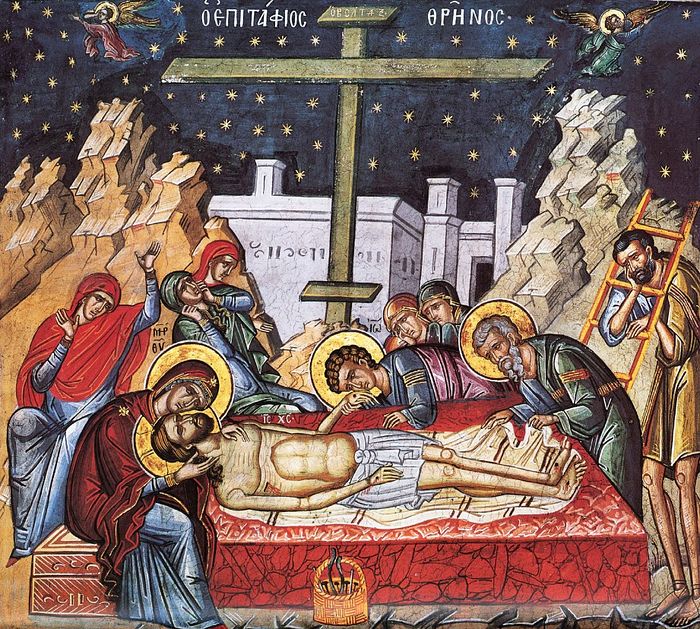
On this day we commemorate the sufferings of Christ: the mockery, the crown of thorns, the scourging, the nails, the thirst, the vinegar and gall, the cry of desolation, and all the Savior endured on the Cross.