Showing posts with label St. Macarius the Great. Show all posts

Tuesday, 17 March 2015

Homily 12

St. Macarius the Great

Concerning the state of Adam before he transgressed God's commandment, and after he had lost both his own image and the heavenly. The Homily contains some very profitable questions.

1. Adam, on transgressing the commandment, suffered a twofold disaster. He lost the pure and lovely possession of his nature, which was after the image and likeness of God; and he lost also that very image in which was laid up for him according to promise all the heavenly inheritance. Suppose there were a coin, bearing the image of the king, and it were stamped afresh with a wrong stamp; the gold is lost, and the image is of no value. Such was the disaster that befell Adam. Great riches and a great inheritance had been prepared for him. Suppose there were a great estate, and it had many sources of revenue in it; here a nourishing vineyard, there fruitful fields, there flocks and herds, there gold and silver; so valuable was the estate before the disobedience, the estate consisting in Adam's own vessel. But when he entertained evil intentions and thoughts, he was lost from God.

Saturday, 14 March 2015

Homily 11

St. Macarius the Great

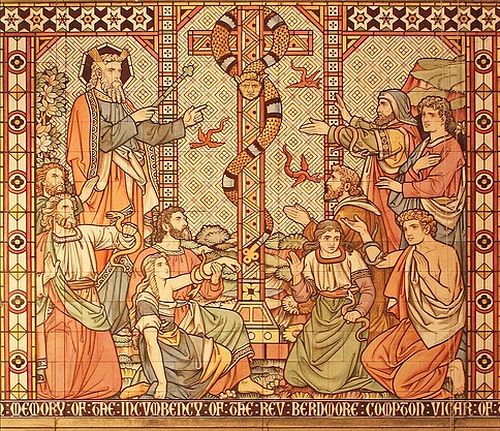
That the power of the Holy Ghost in man’s heart is like fire; and, what things we need, in order to distinguish the thoughts that spring up in the heart; and concerning the dead serpent fixed by Moses at the top of the pole, which was a type of Christ. The Homily contains two dialogues, one between Christ and the evil one, Satan; the other between sinners and the same.

Homily 9

St. Macarius the Great

By lowliness of mind and earnestness the gifts of the Divine grace are preserved, but by pride and sloth they are destroyed.

1. Souls that love truth and God, that long with much hope and faith to put on Christ completely, do not need so much to be put in remembrance by others, nor do they endure, even for a while, to be deprived of the heavenly desire and of passionate affection to the Lord; but being wholly and entirely nailed to the cross of Christ, they perceive in themselves day by day a sense of spiritual advance towards the spiritual Bridegroom.

Thursday, 12 March 2015

Homily 8

St. Macarius The Great

1. A man goes in to bend the knee, and his heart is filled with the divine influence, and his soul rejoices with the Lord, like bride with bridegroom, according to that word of the prophet Esaias which says, As the bridegroom rejoiceth over the bride, so shall the Lord rejoice over thee;1 and it comes to pass that being all day engaged he gives himself to prayer for an hour, and the inward man is rapt in prayer into the unfathomable deep of that other world in great sweetness, so that his whole mind is up aloft, rapt away thither, and estranged from things below. For the time being forgetfulness comes into him with regard to the interests of the earthly mind, because his thoughts are filled and taken captive to divine and heavenly things, to things infinite and past comprehension, to wonderful things which no human lips can express, so that for that hour he prays and says, "Would God that my soul might pass along with my prayer!"

Monday, 9 March 2015

Homily 5

St. Macarius the Great. 

A great difference between Christians and the men of this world. Those who have the spirit of the world are in heart and mind bound in earthly bonds, but the others long after the love of the heavenly Father, having Him only before their eyes with much desire.

Homily 4

St. Macarius the Great 

Christians ought to accomplish their race in this world with heed and care, that they may gain heavenly praises from God and angels. 

1. We who wish to achieve the life of Christianity with any great thoroughness must before anything else cultivate with all our might that faculty of the soul which discerns and discriminates, in order that, having acquired a delicate sense of the difference between good and evil, and always distinguishing the things with which pure nature has been unnaturally adulterated, we may behave ourselves in a straightforward manner, without offence. By using this power of discernment as a kind of eye, we may keep free from any union or connection with the suggestions of sin, and thus the heavenly gift may be vouchsafed to us by which we become worthy of the Lord.

Thursday, 5 March 2015

Homily 3


St. Macarius the Great

That the brethren ought to live in sincerity, simplicity, love, and peace with each other, and to carry on contest and war in their inward thoughts

1. The brethren ought to dwell together in much charity, whether they are praying, or reading the scriptures, or doing some kind of work, that they may have the foundation of mutual charity. In this way, those various inclinations may find favor, and those who pray, and those who read, and those who work, can all live in sincerity and simplicity with each other to their profit. What is written? Thy will be done, as in heaven, so on earth,1 in order that as the angels in heaven dwell together in great concord, peace, and charity, and there is no such thing there as pride, or as envy, but they live together in charity and sincerity, so should the brethren dwell together. Some thirty, perhaps, are under one government; they cannot continue all day and night at one thing. Some give themselves up to prayer for six hours, and then would like to read; others are very ready to serve, while others work at some form of labor.

Wednesday, 4 March 2015

Homily 2

Fifty Spiritual Homilies

St. Macarius the Great

Concerning the kingdom of darkness, that is, of sin, and that God alone is able to take away sin from us, and to deliver us out of the bondage of the evil prince.

1. The kingdom of darkness, the evil prince, having taken man captive at the beginning, enveloped and clothed the soul in the power of darkness, as a man might clothe another. "And that they may make him king, and clothe him with royal garments, so that from head to foot he may wear royal apparel."1 In this manner the evil prince clothed the soul and all its substance with sin. He defiled it all, and brought it all into captivity to his kingdom, leaving not one member of it free from him not the thoughts, not the understanding, not the body; he clothed it all with the purple of darkness. For as it is the body that suffers, not one part or member of it, but the whole is liable to suffer together, so the whole soul suffered the passions of unhappiness and sin. The evil one clothed the whole soul, which is the indispensable part or member2 of man, with his own unhappiness, which is sin, and thus the body became liable to suffering and decay.

HOMILY 1

FIFTY SPIRITUAL HOMILIES 

St. Macarius the Great

Great Lent is wonderful time for increased, concentrated spiritual reading. We are spending less time planning and preparing culinary feasts, we try to distance ourselves more from the empty clatter of television programs and popular movies, and attend more church services. All of this together with the lightness of our Lenten diet aids us in focusing on our spiritual life, in comparing how we live with how the spiritual fathers and mothers of the Church lived, and in receiving their instructions more deeply. In keeping with this edifying trend, OrthoChristian.com will be posting daily homilies from The Fifty Spiritual Homilies of St. Macarius the Egytian, translated by A. J. Mason, D.D. (London: Society For Promoting Christian Knowledge, Northumberland Avenue, W.C., New York: The Macmillan Company, 1921).

Tuesday, 30 April 2013


3 Holy Fathers On the Parable of the Ten Virgins

Saint Macarios the Great

The five wise virgins, watchful and alert, had taken oil in the vessels of their heart. That oil, not part of their own nature, means the grace of the Spirit. They were enabled to enter with the Bridegroom into the heavenly bridal chamber.