
Showing posts with label 8. Holy and Great Monday. Show all posts
Showing posts with label 8. Holy and Great Monday. Show all posts
Monday, 13 April 2020

Sunday, 18 February 2018
Holy Monday
Behold the Bridegroom cometh and blessed is the servant who will be found worthy to receive His saving visitation and put on an incorruptible crown.
The Church prays in these days that no one remain outside of the bridal chamber of Christ where the awesome union of the heart of man with the Spirit of God takes place.
The Apostle Paul has already given us the key today, saying that the Lord is nigh: we must put all our mind and heart on ‘all those things which are true, honest, just, pure, lovely, of good report, virtue and praise’, because this is befitting to Him Who for the sake of our salvation went up to Golgotha to undergo suffering unto death.
Only His undying love is able to heal the wretched desolation of our ingratitude. Ζ
Monday, 10 April 2017
A House of Prayer
  Православие.Ru, 10 апреля 2017 г. http://www.pravoslavie.ru/english/102568.htm Hieromonk Irenei (Pikovsky) Translated by Jesse Dominick  In the name of the Father, and of the Son, and of the Holy Spirit! The Orthodox services of Holy Monday are meaningful and multifaceted. On this day, we prayerfully remember how the Lord warned His disciples of His coming Passion in Jerusalem, gave an answer to the Pharisees about His authority and clarification to the sons of Zebedee about primacy among the disciples, told the parables of the two sons and the evil vinedressers, announced a prophecy of the end times, and cursed the barren fig tree. But historically, four days before the Lord’s Pascha, He probably did two things: drove the moneychangers out of the Temple, and cursed the barren fig tree. Therefore, our services do not so much retell all the events of the Lord’s last entrance into Jerusalem, as they indicate to the members of the Church the necessity to pray, to be vigilant, and to always have a stockpile of virtues, awaiting the coming of the Heavenly Bridegroom. What do these two strange actions, the driving out of the moneychangers from the Temple, and the cursing of the barren fig tree, signify? After the solemn entry into Jerusalem, the Lord entered the Temple, and, making a whip out of some cords, began to drive out from there the sheep and oxen, overturned the moneychangers’ tables, and entreated them to carry the sacrificial doves out of the Temple (cf. Mt. 21:12-13; Mk. 11:15-17; Lk. 19:45-46; Jn. 2:15-16). Forbidding to bring extraneous things through the Temple, He reminded those around of the words spoken through the prophet Isaiah: My house shall be called of all nations the house of prayer,1 and He added, but ye have made it a den of thieves. In our days, Jesus Christ’s zeal for the “house of prayer” is treated in an earthly way by some critics: As the Lord drove the sellers out of the Temple, therefore, any activity of the old ladies behind the candle stand in Orthodox churches falls under the condemnation of “trade.” Does that mean in our modern churches there should be no one and nothing except for parishioners and visitors who have come into the “house of God” to pray? That this is a rather narrow understanding of the Savior’s words, we are told by the realities of the first century and the whole context of the Bible. In antiquity, as in our contemporary churches, there were boxes for collecting donations. The Lord approved of the poor widow’s act, when she put her two mites into the treasury (Mk. 12:42-44). These treasuries in the Jerusalem Temple were protected by a special guard. Our workers, bearing obedience behind the candle stand, often precisely fulfill the function of some kind of guard and make sure that valuables are not stolen from the churches: money, icons, relics, and vessels. Property relations and the reception of donations has been and remains an integral part of a church’s functioning. Jesus Christ not only forbade His disciples to heal lepers, or consider a case with corban as property dedicated to God, or a case of offense towards a brother, but exhorted them to make an offering to the Temple: Be reconciled to thy brother, and then come and offer thy gift (Mt. 5:24, cf. Lk. 5:14, Mk. 7:11). Depending on the social status and material conditions of the carriers, sacrifices could vary from an ox to two turtledoves (see Leviticus). The priests would give a value to this or that sacrifice in antiquity, and maintained the relevant records in special books—so to speak, behind “the candle stand.” According to the book of Acts, the first Christians held all property in common (Acts 2:45), from which the specially-assigned deacons rendered assistance to the needy, widows and orphans (Acts 6:1-6). It is fully possible that already in antiquity there were not only deacons but also deaconesses (see Rm. 16:1), who helped to give assistance from the Church’s cash and gave account for all costs, so to speak, behind “the candle stand.” If the Lord does not forbid man to bring offerings to the Temple and even praises the woman who spent 300 denarii-worth of myrrh on Him (Mk. 14:4-6), that means, the problem is not that we gather offerings for commemorations and candles in the church narthexes, but in something more. Jesus Christ, first and foremost, opposed “house of prayer” to “house of merchandise” (Jn. 2:16), blaming the Jews for turning the “house of prayer” into a “den of thieves” (Lk. 19:46). The concept of a “house of prayer” in the present context goes back to the Jewish expression “Beit tefilah” (בֵּית־תְּפִלָּה, Is. 56:7). “Tefilah” (תְּפִלָּה) is above all supplication, petition, lamentation. David wept for himself: Hear my cry, O God; attend unto my prayer (Ps. 60:1). Through the prophet Isaiah the Lord said to King Hezekiah that He heard his prayer and saw his tears (Is. 38:5). Tefilah is also the intercession of the king or prophet before God for the people (Is. 37:4; Jer. 7:16, 11:14); it is the people’s blessing by the priests (2 Chron. 30:27); it is a prayer of repentance (Dan. 9:3; Neh. 1:6). When God appeared to Solomon at night after the consecration of the first Jerusalem Temple, He said to him, I have heard thy prayer, and have chosen this place to myself for an house of sacrifice. If I shut up heaven that there be no rain, or if I command the locusts to devour the land, or if I send pestilence among my people; If my people, which are called by my name, shall humble themselves, and pray, and seek my face, and turn from their wicked ways; then will I hear from heaven, and will forgive their sin, and will heal their land (2 Chron. 7:12-14). From these words it is clear that forgiveness of sins and the healing of the earth does not come automatically as a prize for enduing afflictions. No, the suffering must humble himself, pray, and turn from his wicked ways. The prophet Isaiah reproaches the people on behalf of God for their mechanical utterance of the words of prayer, when the hearts of those coming to the Temple were occupied by extraneous things. Their fear toward me is taught by the precept of men (Is. 29:13). The Lord invalidates formal prayer: This people honoureth me with their lips, but their heart is far from me (Mk. 7:6). Therefore, the desolation of “the house of prayer” begins with the desolation of the soul of the praying man himself. The “house of prayer” is not simply the building of a church,2 but every place where believers gather to beseech God from the depths of their hearts, as with one mouth.3 For where two or three are gathered in Christ’s name, there He is in the midst of them (see Mt. 18:20). Christ said to the Samaritan Woman, that neither in this mountain, nor yet at Jerusalem, will you worship the Father… But the hour cometh, and now is, when the true worshippers shall worship the Father in spirit and in truth: for the Father seeketh such to worship him (Jn. 4:21, 23). The apostle Paul adds that from henceforth we, having received the grace of Baptism, are the temple of the living God (2 Cor. 6:16) and our bodies are the temple of the Holy Spirit (1 Cor. 6:19). Ye have tasted that the Lord is gracious, writes the apostle Peter, To whom coming, as unto a living stone, disallowed indeed of men, but chosen of God, and precious, Ye also, as lively stones, are built up a spiritual house, an holy priesthood (1 Pt. 2:3-5). Therefore we, as stones of the living house of God, as part of the common body of the Church, must offer up spiritual sacrifices, acceptable to God by Jesus Christ (1 Pt. 2:5). Let us dare to add that the words of the Savior on not making the house of prayer into a den of thieves refer not only to stone churches, and not only to the clergy. The house of God becomes a “den of thieves,” according to the prophet Jeremiah, when people enter into it without clean hearts. Trust ye not in lying words, says Jeremiah, saying, The temple of the Lord are these… Behold, ye trust in lying words, that cannot profit… ye steal, murder, and commit adultery, and swear falsely, and burn incense unto Baal, and walk after other gods whom ye know not; And come and stand before me in this house, which is called by my name, and say, We are delivered to do all these abominations (Jer. 7:4-11). So, a “den of thieves” can be not only those places where they abuse church privileges, but any person in whose soul the passions of envy, deceit, hypocrisy, and resentment at his brother have become the masters. The Lord directly says to such people, first be reconciled to thy brother, and then come and offer thy gift (Mt. 5:24). God will not receive our weeping for our sins, if every one of us does not forgive our brother his trespasses from our hearts (cf. Mt. 18:35, 6:14-15). But worse still will it be for those who were already invited to the Heavenly Bridegroom’s wedding feast, but, disregarding it, went to their field or to trade (cf. Mt. 22:5). Such truly have exchanged their souls for mammon, making their “house of prayer” into a “house of merchandise.” The barren fig tree is not to blame that it had no fruit in early spring (cf. Mk. 11:13). But it’s instantaneous withering at the word of the Lord is a lesson for us. The lush, green external appearance of the fig tree promised fruit, but it had nothing but some leaves. Thus, Lord can wither those who have only the external appearance of fulfilling the Law, but bear no fruits of faith, in the blink of an eye. May these examples, dear fathers, brothers, and sisters, of the cursing of the fig tree and the driving out of the moneychangers from the Temple be a warning for us. To those who do not preserve their baptismal garments white, who are pious only in appearance, but bring forth no fruits of faith, it is useless to repeat the words, “The Temple of the Lord is here.” It’s not worth it to blame others and the clergy and to say that you don’t like to pray in this or that church. God hears our prayers and lamentations for our sins from the depths of our heart in every place. But if someone, going to the “house of God,” harbors a grudge against his neighbor, he has already made his soul a “den of thieves.” Therefore, let us be watchful over our souls and pray, stock up on the oil of virtues, put a wick in the lampadas of faith and go to meet the Bridegroom in the Bridechamber. Let us echo in the house of prayer of our souls the hymn of Holy Week: “Thy bridal chamber I see adorned, O my Savior, but I have no wedding garment that I may enter. O Giver of Light, enlighten the vesture of my soul, and save me.”4 1 Also the sons of the stranger, that join themselves to the Lord, to serve him, and to love the name of the Lord, to be his servants, every one that keepeth the sabbath from polluting it, and taketh hold of my covenant; Even them will I bring to my holy mountain, and make them joyful in my house of prayer: their burnt offerings and their sacrifices shall be accepted upon mine altar; for mine house shall be called an house of prayer for all people (Is. 56:6-7). 2 The expression “house of God” is first met in Holy Scripture in relation to Jacob’s vision of the mysterious ladder, and not in relation to the concrete building of the Temple (see Gen. 28:17). 3 In Acts 16:13 the “place of prayer” is a synagogue, not the Jerusalem Temple. 4 Exaposteilarion of Bridegroom Matins of Holy Monday.
Monday, 6 April 2015
THE BARREN FIG TREE
Metropolitan Tikhon of All America and Canada
Homily delivered at the Bridegroom Matins Service at the Chapel of Saint Sergius of Radonezh April 13, 2014.
In the Name of the Father, and of the Son, and of the Holy Spirit.
In the Gospel reading we have just heard, our Lord and Savior Jesus Christ offers 3 parables for our edification.
The first parable speaks to us of the Fig tree which had leaves but was barren of any fruit. With this image, the Lord is rebuking those around Him who adorned themselves with the greenery of external piety but were devoid of inner virtue, as well as those who throughout history, had become slaves to the law and had not borne the fruit of the spirit.
Thursday, 2 May 2013
Tuesday, 30 April 2013

Nikolai Velimirovich:
Being “in Adam” and “in Christ”
“For just as in Adam all die, so too, in Christ, shall all be brought to life” (1 Corinthians 15:22).
Following Adam’s example, life is sown in shame, and following Christ’s example, life is raised in glory.
Sin is from Adam and justice is from Christ. Weakness and death come from Adam and strength and life come from Christ.
Accordingly, in Adam we all die. Accordingly, in Christ, we shall all be brought to life.
Monday, 29 April 2013

Sermon On Joy After Sorrow
by St. Nikolai Velimirovich
"So you also are now in anguish. But I will see you again, and your hearts will rejoice" (John 16:22).
The father steps up to the gallows and his sons are crying around him. Instead of the sons comforting him, he comforts his sons. Something similar to this happened to the Lord and His disciples. Walking toward His bitter death, the Lord is more saddened because of the grief of His disciples, rather than by that which He has to endure. He caresses them with consolation and encourages them with the prophecy of the new and impending vision: "But I will see you again." This is a prophecy about the resurrection.

Who Sold Joseph Into Slavery?
By St. Nikolai Velimirovich
Abba John the Short asked the monks: "Who sold Joseph?" [Genesis 37-50] One monk replied: "His brothers." To that, the elder replied: "No brethren, rather his humility. Joseph could have said that he is their brother and could have protested to being sold but he remained silent. His humility, therefore, sold him. Afterward, this same humility made him master over Egypt." In surrendering ourselves to the will of God, we defend ourselves too much from external unpleasantness, that is why we lose the good fruits which is harvested at the end of unpleasantness endured with humility. Abba Pimen wisely spoke: "We have abandoned the easy yoke, i.e., self-reproach and we have burdened ourselves with a heavy yoke, i.e., self-justification." The Christian accepts every unpleasantness as deserving of their present or their past sins; seeking in all the will of God with faith and awaiting the end with hope.

A Homily on Joseph, the Chaste and Innocent
By St. Nikolai Velimirovich
"And Joseph left his garment in her hand, and fled outdoors" (Genesis 39:12).
The innocent and chaste Joseph endured two great and difficult temptations and overcame them: the temptation of wicked envy on the part of his blood brothers, and the temptation of adulterous passion from the Egyptian temptress. Jealousy sold him as a slave, and the passion of adultery drove the innocent one to prison.
 Enter in Great Week
Fr. Vasileios
Kalliakmanis
a) Joseph the Most Comely[1] leads the chorus of the
celebrants at the great and universally important event of divine compassion,
the path of the Lord to His voluntary suffering. In his person, the Gospel
messages of reconciliation and forgiveness, of mature restraint and purity of
heart all find their application.
 BIBLE SET OUT FOR FAMILY READING
GREAT MONDAY
Curse of the fig tree parable incriminating
On this day - the second after the grand entrance into Jerusalem - coming back to town in the morning, Jesus Christ, "he was hungry and saw a fig tree by the road, went up to her and found nothing thereon, but leaves only, and said unto it, Let no will also continue to fruit from you again. And immediately the fig tree withered away. "(Jn 12, 24-33, 35-36, 46-48. Mt. 21, 18-19)
 The Services Of The Bridegroom
Sunday Evening through Tuesday Evening
Introduction
Beginning on the evening of Palm Sunday and continuing through the evening of Holy Tuesday, the Orthodox Church observes a special service known as the Service of the Bridegroom. Each evening service is the Matins or Orthros service of the following day (e.g. the service held on Sunday evening is the Orthros service for Holy Monday). The name of the service is from the figure of the Bridegroom in the parable of the Ten Virgins found in Matthew 25:1-13.
Background
Passion Week: Holy and Great Monday
Archpriest Victor Potapov, Metropolitan Anthony of Sourozh
On Passion Week
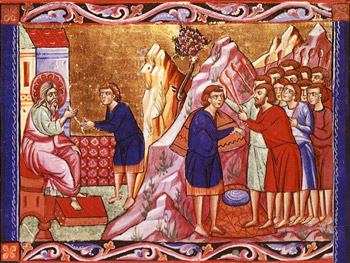
Jacob, Joseph, and his brothers.
We are entering into difficult days today: days when we recall the Passion of Christ; days when it will be difficult for us to come to church and endure long services, to pray. Many ask themselves: is there any point in coming to services when we are so physically tired, when our thoughts are flying here and there, when we have no inner concentration and true participation in what is going on?
Subscribe to:
Posts (Atom)