Sunday, 24 February 2019

The Sunday of the Prodigal Son

Monk Agapios of Kyriakodromion

God is always good and kind to everyone, more than patient with us. But He manifests His great goodness in particular towards those who are sinning. It looks as though He burdens the righteous on all sides and doesn’t give them any respite, yet He’s much more compassionate towards sinners and more easily moved to sympathy for them. He pulls them out from the cadaver of sin and brings them to repentance. The Lord says: ‘As I live, I do not desire the death of sinners, but that they should turn and live. Should the fallen not be raised? Should those who have turned away not turn back? Turn to me and I shall turn to you’. To the righteous, He says: ‘If you observe all righteousness and truth, and if you keep all my commandments and then fall into sin, I will not remember your righteousness, but you shall die in your sin’. The Lord is very strict towards the righteous, but has sympathy, immeasurable compassion and infinite goodness towards sinners. This is because, being all-wise, He knows not to frighten those who have sinned against Him, lest they fall into despair; whereas if He praises the righteous, He’ll encourage complacency. And so He shows mercy to sinners but puts His fear into the righteous, as He is terrible among the saints.
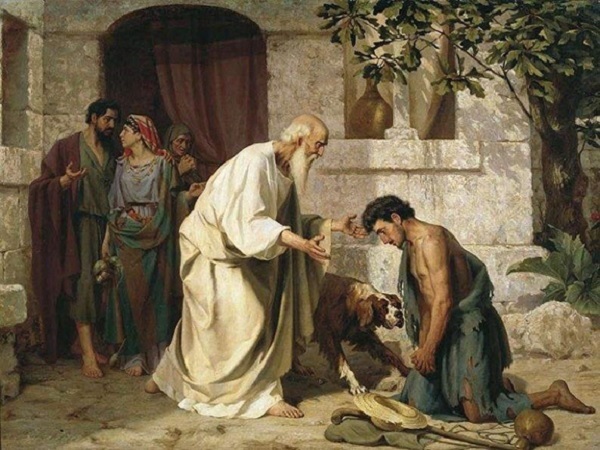
Therefore, being compassionate and seeking and desiring the salvation of sinners, He’s given us repentance as the cure and medicine. He teaches each of us the path of return and repentance through various sayings, parables and challenges, prompting us to reform. This is why today’s parable shows Him as merciful and compassionate.
There was a man who had two sons; and the younger of them said to his father, ‘Father, give me the share of the property that falls to me’. So he divided his living between them, giving half to the younger son. This parable demonstrates and manifests the power of the repentance of the returning penitent and the boundless extent of divine compassion, through which God prompts and urges sinners to repent. It calls God, Who loves the human race, ‘a father’, and both orders of people, the righteous and the sinners, ‘sons’.
Since righteousness is the oldest part and possession of human nature, this is why the elder son is called ‘righteous’, because, from the outset, human nature was embellished and dignified with righteousness, from the very beginning of its divine creation. Holy Scripture tells us that God saw what He’d made and it was very good. Because sin came later, this is why the younger son is called the sinner, since his mind and outlook were unstable and uncertain. The younger son asked his father to give him his share and the father, who loved them both equally, did so, leaving them both self-sufficient. He gave the heavens, the sun, the moon, the stars, the earth and all the things therein for the enjoyment of all, the righteous and the sinners both. Neither has more than the other: the sun rises on both equally; the rain falls on everyone; and God’s blessing and benefits which He’s given in such abundance are to be enjoyed by one and all, without let or hindrance.
The younger son saw the heavens and deified them; he saw the fruits of the earth and didn’t put them to their best use; he didn’t observe God’s law but was ill-disposed towards the righteous and God’s holy prophets. Impious and sinful, he took the sun for his enjoyment and worshipped the gift as a god. He honoured the gifts but didn’t recognize the Giver. He worshipped the creation instead of the Creator. The elder, righteous son used all of these things God made for His glory and praise. He saw the heavens and, from their beauty, recognized the Creator and Primogenitor. ‘For I will regard the heavens, the work of your fingers; the moon and stars, which you have established’. He saw the world and praised and glorified the Lord Who embellished it. The righteous, who was grateful and an indispensable servant, lauded and admired the creation and therefore magnified and glorified the Creator. The sinner, though, who was ungrateful and good for nothing, also saw [the creation] and- wrongly- worshipped it.
All of us have both reason and free will and proceed as we think best. We’re not under compulsion, and virtue or wicked dealings depend on our own inclinations. Each of us can live well, in a God-pleasing manner, since we have reason and free will. This is why we praise those who have good intentions, who do good voluntarily and freely, not having been forced to do so by others. It’s not right nor reasonable to praise those who are brought back from wickedness and impiety by force or compulsion, but it is proper to recognize those who reform of their own free will. If someone is possessed of a virtue by their nature, it’s not tested; it’s only praiseworthy and redemptive when it’s exercised knowingly. So what did the younger son do when he took his inheritance? He sold it and lived the life of a prodigal. He spent lavishly and after a few days took what was left and went to another country altogether, where he threw his money away on riotous living and all manner of transgressions.

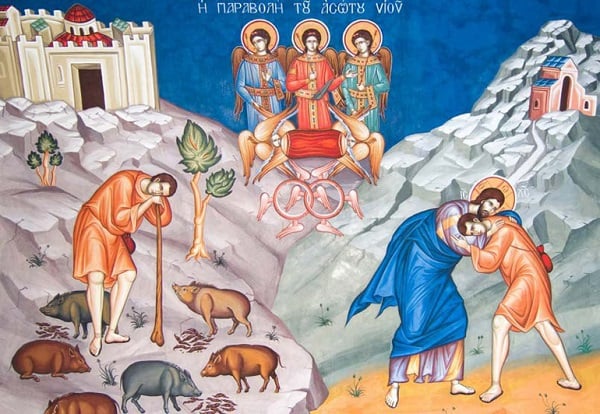
Sermon on the Apostolic reading for the Sunday of the prodigal son


In the parable of the “Prodigal Son,” which we heard from the Holy Gospel (Luke 15:11-32), we saw a situation where a man embraces “prodigal living.” He was a free man who became a slave, and grazed with the “pigs” of his fleshly passions.
This is what the Apostolic Reading is also talking about. The Apostle Paul does not hesitate to characterize sin and call it by its name. This is a contrast to what we observe in our days, in that the most obscene and unnatural acts are promoted and displayed for imitation; and that modern people cannot be held captive by the ideas of ancient times! The Apostle Paul clearly states: “The body is not for sexual immorality, but to glorify the Lord” (verse 13). And the Apostle cried: “Flee sexual immorality. Every other sin that a man does is outside his own body; but he who commits sexual immorality sins against his own body” (verse 18). The most destructive sin for the body is the one that is committed against itself. How many people have been wiped out by diseases, which in our days have evolved into epidemics!

To those who claim today that “my body belongs to me and I am free to do with it as I want,” the Apostle Paul gives the following answer: “You do not know that your body is the temple of the Holy Spirit Who is in you, whom you have from God, and you are not your own? For you were bought at a price”(verses 19-20).

Sunday, 17 February 2019

The Sunday of the Canaanite Woman

From the Kyriakodromion of Monk Agapios
At that time, Jesus went to the district of Tyre and Sidon. And behold, a Canaanite woman from that region came out and cried, “Have mercy on me, Lord, Son of David; my daughter is severely possessed by a demon”’. The Lord prevented His disciples from going into the lands of the pagans, but He Himself went to Tyre and Sidon which were towns where Hellenes* lived. He did so in order to condemn the lack of faith on the part of the Jews. So the Canaanite woman, who must have learned of the Lord’s reputation earlier, heard that He had come to that part of the country and approached Him crying: ‘Have mercy on me, Lord, Son of David; my daughter is severely possessed by a demon’. With these words, the woman confessed the accuracy of her faith and shamed the Jews for not being persuaded by the words of Christ, the Saviour. She didn’t know the Law, hadn’t studied the Prophets, yet called Him God and human when asking for His mercy. By saying ‘Have mercy on me, Lord’, she acknowledged His divinity; with ‘Son of David’, His humanity.
And she didn’t say: ‘Come and heal my daughter, Lord’, but ‘Have mercy on me’ (because, miserable wretch that I am, I’m in pain and anguish over the suffering of my daughter). The latter was left alone at home, sick and almost unconscious, but the mother felt her pain and anguish all the more, precisely because she was a mother.

Sunday, 18 February 2018

Lazarus’ Saturday

The Life-giving Word said: Lazarus come forth’ and the one who slept took on living breath.
And today the Lord of the Living says: ‘I am the Resurrection’, ‘whoever believes in me, though he were dead yet shall he live’.

Palm Sunday

This present day is a prophetic event, a glimmer of the glory of Christ, which will be revealed in all its fullness at the end of the ages.
Today the Lord enters into Jerusalem and the whole city is shaken. On the last day He will come with glory and the entire earth will quake, so that all those things that are shaken may be removed, as ‘things that are made’, and only the things which cannot be shaken might remain, marked with the incorruptible grace of the Almighty Jesus.
During His entrance to Jerusalem, the Jews did not apprehend the real identity of the meek and humble Messiah, who was visiting them riding on a donkey’s colt.
And we now, in order to known the visitation of the Lord, that our house not remain desolate, but learn the meekness and humility of the Saviour God, and through His grace to stand in His Presence and sing ‘Blessed is He who Cometh in the Name of the Lord’.
As the children of the Jews spread out their clothing so Christ the Messiah could pass over it and bless them, thus we also spread out the impulses of our will and our desires so that the Lord may rule over our free heart. Then, His grace will cover us, so that we become His own forever.

Holy Monday

Behold the Bridegroom cometh and blessed is the servant who will be found worthy to receive His saving visitation and put on an incorruptible crown.
The Church prays in these days that no one remain outside of the bridal chamber of Christ where the awesome union of the heart of man with the Spirit of God takes place.
The Apostle Paul has already given us the key today, saying that the Lord is nigh: we must put all our mind and heart on ‘all those things which are true, honest, just, pure, lovely, of good report, virtue and praise’, because this is befitting to Him Who for the sake of our salvation went up to Golgotha to undergo suffering unto death.
Only His undying love is able to heal the wretched desolation of our ingratitude. Ζ
These holy days we do not just commemorate the Passion of the Lord, but through the grace that the Church has bestowed upon us during Great Lent, we become contemporaries of His Passion.
The Lord is the Lamb of God ‘slain from the foundation of the world’. He is continually slain for us unto the end of the ages, so that we, His enemies, might enjoy unending delight in the Body and Blood of His Covenant.
Today, the covenant which the Lord concludes with His people is the covenant of His love unto the end. From our side, this covenant demands resistance to sin unto blood. This is the talent with which we trade in a godly manner, so as to acquire the Lord as Saviour and Friend.
Thus we become His own forever and inherit the boundless freedom of His love, hating only whatsoever opposes it.
The Lord came to send fire upon the earth. As He makes His way towards Golgotha, this fire flares up and transforms whatsoever draws near:
The tax collectors become merciful and give away their possessions. Their heart is enlarged fourfold.
The infants are made wise and perfect a hymn of gratitude to God, Who ‘comes meek, humble and having salvation’ (Zach. 9:9).
The prostitutes are made chaste and the madness of their depraved life is turned into insatiable love for God.
The thief is enlightened and becomes an excellent teacher of the justice of the Cross, so that on the very same day Paradise is opened.
The mystery of the love of Christ is great and incomprehensible, only a burning heart is able to grasp it even a little.
We need a garment of humility in order to come into the quickening presence of the suffering Lord of Glory, and receive the anointing of His saving wisdom.

Holy Thursday


Today is the anniversary of the institution of the Divine Liturgy, which the Lord gave us in a prophetic way before His Passion and sealed with His blood on Golgotha.
The Lord expressed this Covenant through His holy word, saying:  ‘He that eateth My flesh and drinketh My blood, dwelleth in Me, and I in him. As the living Father hath sent Me, and I live by the Father, so he that eateth Me even he shall live by Me.’
The terms of this New Covenant of the Lord are the programme of the life of all who have faith and partake of Christ, who will inherit His Unfading Life: ‘Ye are they which have continued with Me in My temptations. And I appoint unto you a Kingdom as My Father hath appointed unto Me, that ye may eat and drink at My table in My Kingdom.’ Z

Sunday, 11 February 2018

Easter

‘Fear not; I am the First and the Last, I am He that liveth, and was dead; and, behold, I am alive for evermore’ (Rev. 1:17-18). These are the words of the Risen Christ to His beloved disciple, John the Theologian. These words, describe the path of the Lord, but also of man, which goes through death and leads to eternal life.
The Lord loved mankind with a perfect love. He died for all who were condemned to death because of the ancestral sin. The unjust death of the Lord became a condemnation of the just death of all men, bestowing upon them eternal salvation. ‘Christ is risen from the dead, and there is none left in the tomb.’