https://youtu.be/miSwLh9Ns1o?si=UiiNMqYIQy6_OOm7

Showing posts with label The Sunday Of The Prodigal Son. Show all posts
Showing posts with label The Sunday Of The Prodigal Son. Show all posts
Tuesday, 15 July 2025

Sunday, 24 February 2019
The Sunday of the Prodigal Son
Monk Agapios of Kyriakodromion
God is always good and kind to everyone, more than patient with us. But He manifests His great goodness in particular towards those who are sinning. It looks as though He burdens the righteous on all sides and doesn’t give them any respite, yet He’s much more compassionate towards sinners and more easily moved to sympathy for them. He pulls them out from the cadaver of sin and brings them to repentance. The Lord says: ‘As I live, I do not desire the death of sinners, but that they should turn and live. Should the fallen not be raised? Should those who have turned away not turn back? Turn to me and I shall turn to you’. To the righteous, He says: ‘If you observe all righteousness and truth, and if you keep all my commandments and then fall into sin, I will not remember your righteousness, but you shall die in your sin’. The Lord is very strict towards the righteous, but has sympathy, immeasurable compassion and infinite goodness towards sinners. This is because, being all-wise, He knows not to frighten those who have sinned against Him, lest they fall into despair; whereas if He praises the righteous, He’ll encourage complacency. And so He shows mercy to sinners but puts His fear into the righteous, as He is terrible among the saints.
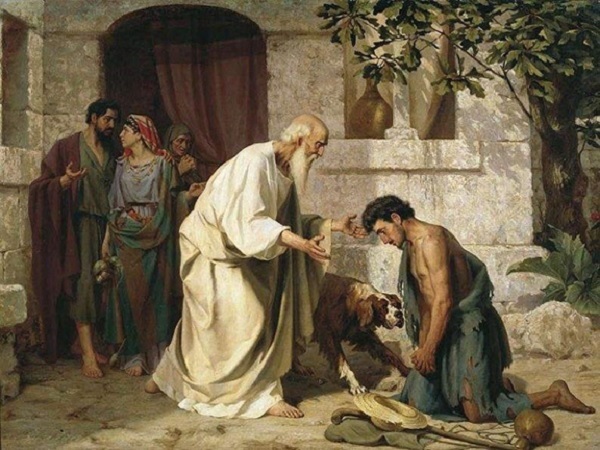
Therefore, being compassionate and seeking and desiring the salvation of sinners, He’s given us repentance as the cure and medicine. He teaches each of us the path of return and repentance through various sayings, parables and challenges, prompting us to reform. This is why today’s parable shows Him as merciful and compassionate.
There was a man who had two sons; and the younger of them said to his father, ‘Father, give me the share of the property that falls to me’. So he divided his living between them, giving half to the younger son. This parable demonstrates and manifests the power of the repentance of the returning penitent and the boundless extent of divine compassion, through which God prompts and urges sinners to repent. It calls God, Who loves the human race, ‘a father’, and both orders of people, the righteous and the sinners, ‘sons’.
Since righteousness is the oldest part and possession of human nature, this is why the elder son is called ‘righteous’, because, from the outset, human nature was embellished and dignified with righteousness, from the very beginning of its divine creation. Holy Scripture tells us that God saw what He’d made and it was very good. Because sin came later, this is why the younger son is called the sinner, since his mind and outlook were unstable and uncertain. The younger son asked his father to give him his share and the father, who loved them both equally, did so, leaving them both self-sufficient. He gave the heavens, the sun, the moon, the stars, the earth and all the things therein for the enjoyment of all, the righteous and the sinners both. Neither has more than the other: the sun rises on both equally; the rain falls on everyone; and God’s blessing and benefits which He’s given in such abundance are to be enjoyed by one and all, without let or hindrance.
The younger son saw the heavens and deified them; he saw the fruits of the earth and didn’t put them to their best use; he didn’t observe God’s law but was ill-disposed towards the righteous and God’s holy prophets. Impious and sinful, he took the sun for his enjoyment and worshipped the gift as a god. He honoured the gifts but didn’t recognize the Giver. He worshipped the creation instead of the Creator. The elder, righteous son used all of these things God made for His glory and praise. He saw the heavens and, from their beauty, recognized the Creator and Primogenitor. ‘For I will regard the heavens, the work of your fingers; the moon and stars, which you have established’. He saw the world and praised and glorified the Lord Who embellished it. The righteous, who was grateful and an indispensable servant, lauded and admired the creation and therefore magnified and glorified the Creator. The sinner, though, who was ungrateful and good for nothing, also saw [the creation] and- wrongly- worshipped it.
All of us have both reason and free will and proceed as we think best. We’re not under compulsion, and virtue or wicked dealings depend on our own inclinations. Each of us can live well, in a God-pleasing manner, since we have reason and free will. This is why we praise those who have good intentions, who do good voluntarily and freely, not having been forced to do so by others. It’s not right nor reasonable to praise those who are brought back from wickedness and impiety by force or compulsion, but it is proper to recognize those who reform of their own free will. If someone is possessed of a virtue by their nature, it’s not tested; it’s only praiseworthy and redemptive when it’s exercised knowingly. So what did the younger son do when he took his inheritance? He sold it and lived the life of a prodigal. He spent lavishly and after a few days took what was left and went to another country altogether, where he threw his money away on riotous living and all manner of transgressions.
Sermon on the Apostolic reading for the Sunday of the prodigal son
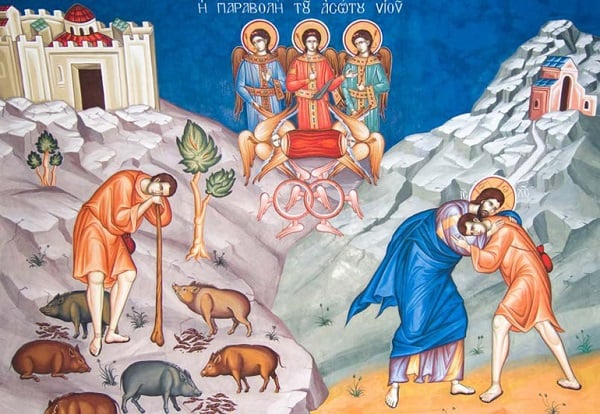
In the parable of the “Prodigal Son,” which we heard from the Holy Gospel (Luke 15:11-32), we saw a situation where a man embraces “prodigal living.” He was a free man who became a slave, and grazed with the “pigs” of his fleshly passions.
This is what the Apostolic Reading is also talking about. The Apostle Paul does not hesitate to characterize sin and call it by its name. This is a contrast to what we observe in our days, in that the most obscene and unnatural acts are promoted and displayed for imitation; and that modern people cannot be held captive by the ideas of ancient times! The Apostle Paul clearly states: “The body is not for sexual immorality, but to glorify the Lord” (verse 13). And the Apostle cried: “Flee sexual immorality. Every other sin that a man does is outside his own body; but he who commits sexual immorality sins against his own body” (verse 18). The most destructive sin for the body is the one that is committed against itself. How many people have been wiped out by diseases, which in our days have evolved into epidemics!
To those who claim today that “my body belongs to me and I am free to do with it as I want,” the Apostle Paul gives the following answer: “You do not know that your body is the temple of the Holy Spirit Who is in you, whom you have from God, and you are not your own? For you were bought at a price”(verses 19-20).
To those who claim today that “my body belongs to me and I am free to do with it as I want,” the Apostle Paul gives the following answer: “You do not know that your body is the temple of the Holy Spirit Who is in you, whom you have from God, and you are not your own? For you were bought at a price”(verses 19-20).
Sunday, 28 February 2016
Sermon on the Sunday of the Prodigal Son
 Georgios Patronos
Introduction
The parable of the Prodigal Son, which is the Gospel reading for today, is, as is well-known, one of the most beautiful texts of world literature.
It also recalls for us the Classical narrative, from Greek mythology, of the adventure of Odysseus who left Ithaca in order to become a man and wiser than before. This is to do with the eternal quest which people undertake, within time and history, leaving everything- certainty and security- to seek the unobtainable, the dream, and, in the end, made wiser by this experience of life, to return to their home and roots, where they eventually find rest.
How do we treat the gifts of God? The Sunday of the Prodigal Son
In the Name of the Father, the Son and the Holy Spirit.
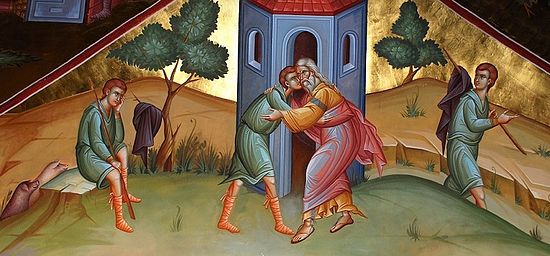
How simple and how restrained are the words in which the Gospel describes his cruel rejection of his father, and prepares his departure into the far, strange country! “Father, give me my part of thy inheritance!” Do these words not mean: “Father, I can’t wait until your death! You are still strong, and I am young; it is now that I want to reap the fruits of thy life, of thy labors; later they will grow stale. Let us come to an agreement: for me you are dead; give me what belongs to me or what would belong to me after your actual death, and I will go, and I will live the life I have chosen.”
Wednesday, 11 February 2015
Sermon on the Sunday of the Prodigal Son
Metropolitan Kallistos (Ware)
Metropolitan Kallistos Ware delivers his sermon on the Sunday of the Prodigal Son in the presence of Metropolitan Nicholas at the Sts. Constantine & Helen Greek Orthodox Church in Westland, MI.
Sunday, 16 February 2014
Sermon on the Sunday of the Prodigal Son

Georgios Patronos 
Introduction
Prodigal Son, which is the Gospel reading for today, is, as is well-known, one of the most beautiful texts of world literature.
It also recalls for us the Classical narrative, from Greek mythology, of the adventure of Odysseus who left Ithaca in order to become a man and wiser than before. This is to do with the eternal quest which people undertake, within time and history, leaving everything- certainty and security- to seek the unobtainable, the dream, and, in the end, made wiser by this experience of life, to return to their home and roots, where they eventually find rest.
Saturday, 15 February 2014
Sunday Of The Prodigal Son

The Second Sunday Of The Triodion Period:
Introduction
The Sunday of the Prodigal Son is the second Sunday of a three-week period prior to the commencement of Great Lent. On the previous Sunday, the services of the Church began to include hymns from the Triodion, a liturgical book that contains the services from the Sunday of the Publican and the Pharisee, the tenth before Pascha (Easter), through Great and Holy Saturday. As with the Sunday of the Publican and the Pharisee, the theme of this Sunday is repentance, and the focus on the parable of the Prodigal Son leads Orthodox Christians to contemplate the necessity of repentance in our relationship with our Heavenly Father.
SYNAXARION WEEK OF THE PRODIGAL SON
 Who, like me, a fornicator, - go, go:
After all, God's bounty for all the open door.
On this day we celebrate the return of the prodigal son, which is the divine fathers put in transistors in second place for the following reason.
As some of you know of a lot of transgressions, from youth alive whoring, spending time idly, in drunkenness and uncleanness, and thus having run into the depths of evils, are giving up, which is the offspring of pride. Therefore, they did not want to go to the correct, exposing (as an excuse) capture evil, causing flow into the more evil.
Instruction on the Sunday of the Prodigal Son. On Repentance
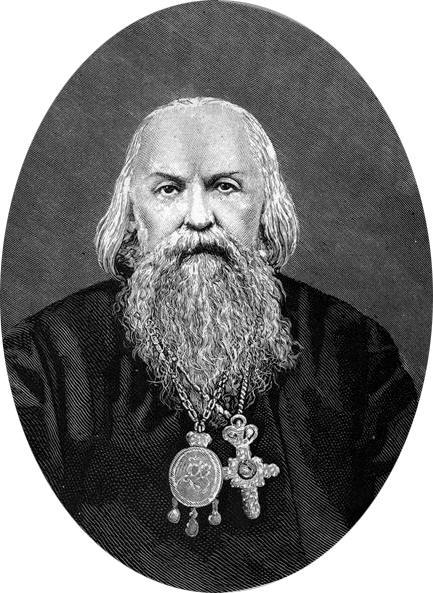 St. Ignatius (Brianchaninov)
Beloved brethren! The Holy Church, the loving mother of all her children, who gave them birth unto salvation, and takes upon herself all care to ensure that her children not lose their inheritance—Heaven, preparing them for the successful completion of the forthcoming podvig of the Forty Days Fast, has ordained that we read today at the Divine Liturgy the parable of our Lord Jesus Christ about the prodigal son.
In what does the podvig of the holy Forty Days Fast consist? In the podvig of repentance. During these days, we stand before the time dedicated largely to repentance, as before the doors of repentance, and sing the song that is filled with contrite feeling: Open unto me the doors of repentance, O Giver of life! What does our Lord’s Gospel parable that we hear today reveal to us? It reveals the unfathomable, infinite mercy of our Heavenly Father for sinners who bring forth repentance. The Lord made it known to people, calling them to repentance: Likewise, I say unto you, there is joy in the presence of the angels of God over one sinner that repenteth (Lk. 15:10). So that His words would become even more strongly impressed in the hearts of His listeners, He decided to supplement them with a parable.
Homily on the Prodigal Son

Cyril of Alexandria,
From the Commentary on the Gospel of St. Luke, Homily 107.
I HEAR one of the holy prophets trying to win unto repentance those who are far from God, and saying, "Return, O Israel, to the Lord your God: for you have become weak in your iniquity. Take with you words, and return to the Lord our God." What sort of words then did he, under the influence of the Spirit, command them to take with them? Or were they not such as become those who wish to repent; such namely, as would appease God, Who is gentle, and loves mercy. For He even said by one of the holy prophets, "Return you returning children, and I will heal your breaches." And yet again by the voice of Ezekiel, "Return you altogether from your wickednesses, O house of Israel. Cast away from you all your iniquities which you have committed, that they be not to you for a punishment of iniquity. For I have no pleasure in the death of the sinner, as that he should turn from his evil way and live." And the same truth Christ here also teaches us, by this most beautifully composed parable, which I will now to the best of my ability endeavour to discuss, briefly gathering up its broad statements, and explaining and defending the ideas which it contains.
The Prodigal Son and The Father’s House
 Fr. Thomas Hopko
Fr. Thomas takes a second look at the story of The Prodigal Son, this time focusing on the meaning of The Father's House.
As Christians meditate on the parable of the Prodigal Son during the pre-Lenten season and the Lenten season, because all during this time of year we will be hearing in church about this parable, about the mercy of God, about the gifts of God given to us, about our wasting of those gifts, about our going off into a far country, of being out there among the swine and coming to ourself and getting up and returning back to God and knowing that he accepts us. As we meditate on all those things, in the Orthodox tradition it has been traditional to somehow invision, or envisage, the Church itself as the house of the Father, the household of God.
Our Portret
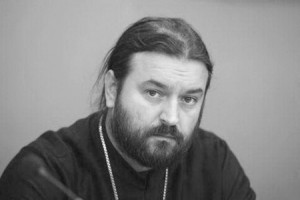 Archpriest Andrei Tkachev
Everybody has heard of Liberty, Equality and Fraternity. It should be clear that those stolen from the New Testament concept of the French Revolution changed considerably meaning associated with the image of a naked lady in the Phrygian cap and on the barricades.
If you forget that "the Lord is that Spirit: and where the Spirit of the Lord is, there is freedom" (2 Cor. 3:17), the word "freedom" will slip out of your hands like a live fish, or disappear like vapor, or become so heavy that people will voluntarily give up the freedom.
Reflections on the Sunday of the Prodigal Son

'All to no purpose have I left my true home...'
The second Sunday of the Triodion, the second Sunday before the Vespers of Forgiveness and the beginning of Great and Holy Lent, is dedicated to the recollection of the Prodigal Son (Lk 15.11-32). 'A certain man had two sons', both highly favoured, one of a more rebellious spirit than the other. The story, perhaps among the most well-loved of the Gospel parables, though it appears only in the Gospel of Luke, is familiar to most. The wealth of the young son is squandered by his raucous living, and from the mire of his agony (literally, from the mud of a pig-stall) he has a change of heart and returns home, humbled. His father, certainly justified in any anger he might choose to show, instead embraces his 'prodigal' with tears and sets a mighty feast. 'For my son was lost, and now is found'.
The spirit of exile and the sin of man

Reflections on the sin, 'fall', and the sinful condition of humanity
A consideration of the issues of sin, 'fall', and humanity's sinful condition, grounded in the parable of the Prodigal Son and the theme of exile in the Lenten liturgical texts.
I was enslaved to strangers, an exile in the land of corruption,and I was filled with shame.
But now I return, merciful Lord,
and cry to Thee: I have sinned.[1]
Subscribe to:
Posts (Atom)