Friday, 3 May 2013

Epithets for the Passion of Christ

Holy Week allows us to contemplate the Passion of Christ. In the Orthros for Holy Monday, we hear the following First Kathisma:

"On the day at hand, like a lifesaving beacon, the honorable Passion breaks on the world. For Christ in His goodness presses on to His sufferings. Though He holds all creation in the hallow of His hand, yet He deigns to be suspended on the Cross to save mankind."

And the Third Kathisma reads:

SERVICES ON HOLY FRIDAY


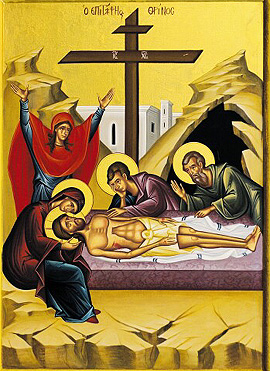
Holy Friday, the burial of Jesus Christ
Holy Friday, also known as Good Friday, or Great Friday, is a holiday observed primarily by Christians commemorating the crucifixion of Jesus Christ and his death at Calvary. The holiday is observed during Holy Week as part of the Paschal Triodion on the Friday preceding Easter Sunday.

Based on Christian scriptural details of the Sanhedrin Trial of Jesus, the Crucifixion of Jesus was most probably on a Friday (John 19:42). The estimated year of Good Friday is AD 33.

In the afternoon, around 3 pm, all gather for the Vespers of the Taking-Down from the Cross, commemorating the Deposition from the Cross. The Gospel reading is a concatenation taken from all four of the Gospels. During the service, the body of Christ is removed from the cross, as the words in the Gospel reading mention Joseph of Arimathea, wrapped in a linen shroud, and taken to the altar in the sanctuary.

SYNAXARION FOR HOLY AND GREAT FRIDAY


On this day, Holy and Great Friday, we celebrate the awesome, holy, and saving Passion of our Lord and God and Savior Jesus Christ—the spitting, the blows with the palm of the hand, the buffeting, the mockery, the reviling, the wearing of the purple robe, the reed, the sponge, the vinegar, the nailing, the lance, and above all, the Crucifixion and Death which He condescended to endure willingly for our sakes—and also the saving confession of the grateful thief upon the cross.

After our Lord Jesus Christ was sold for thirty pieces of silver and was betrayed by a friend and disciple, He was led to Annas the High Priest. Annas again sent the Lord to Caiaphas, where He was spat upon and at the same time mocked and laughed at. He heard them saying to Him, "Prophesy to us, Christ! Who is the one that struck you?" (Matt. 26:68). Then many false witnesses and accusers arrived, perhaps because He said, "Destroy this temple, and in three days I will raise it up" (John 2:19) and because He said about Himself, "I am the Son of God" (Matt. 27:43), or because He said, "Nevertheless, I say to you, hereafter you will see the Son of Man sitting at the right hand of the Power and coming on the clouds of heaven" (Matt. 26:64).

Thursday, 2 May 2013

What Great Thursday Tells Us
Petros Panayiotopoulos

As we progress towards the Passion, events unfurl with dramatic speed, rich in significance and with a breathtaking plot as they proceed towards their culmination.

We’ve already seen two actions which are related to the person of Christ and which are entirely opposite in nature. On the one hand, there was the sinful woman who came to Christ and paid Him humble honours; and, on the other, there’s one of His disciples, who reneges against Him and approaches the High Priests and Scribes in order to betray Him.


The King Who Does Not Defend Himself
by St. Nikolai Velimirovich

“Do you think that I cannot call upon My Father and He will not provide Me at this moment with more than twelve legions of angels” (Matthew 26:53).

Thus spoke the Lord to the disciple who drew the sword to defend his Teacher in the Garden of Gethsemane. It is obvious from these words that the Lord could have defended Himself, if He wanted to, not only from Judas and his company of guards, but also from Pilate and the leaders of the Jews. For the might of one angel is greater than the greatest army of men, much less the might of twelve legions of angels.

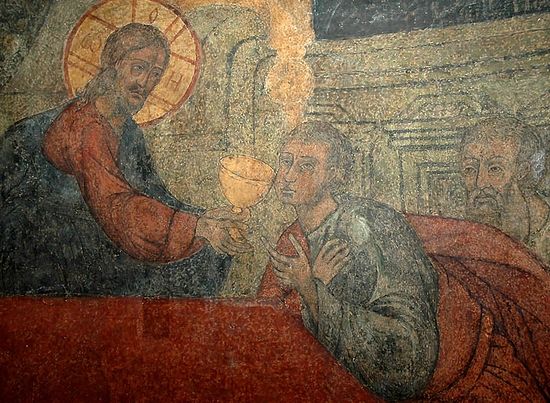
THE MYSTICAL (LAST) SUPPER
On the fifth day after the Lord’s entrance into Jerusalem, which, according to our reckoning, was Thursday (on Friday evening, the first day of unleavened bread, they sacrificed the Passover lamb),the disciples came to Jesus saying, "Where will you have us prepare the Passover for you to eat?"

Jesus Christ said to them, "Go into the city, and a man carrying a jar of water will meet you. Follow him and, wherever he enters, say to the householder, ‘The Teacher says where is My guest room, where I am to eat the Passover with My disciples?’ And he will show you a large upper room furnished and ready. There, prepare for us."

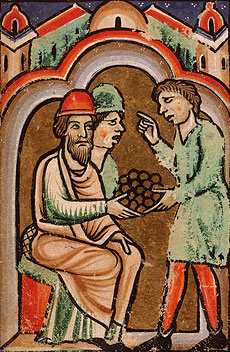
Judas receiving thirty pieces of silver from the Jewish high priests.
ON THE "GOSPEL" OF JUDAS
Following the broadcast on Sunday 9 April on the National Geographic Channel of a programme about the 'gospel of Judas', these are the answers of Fr Andrew to questions in an interview in Russian for Russian Television, conducted in St John the Wonderworker Church in Felixstowe on 11 April 2006.

1. The 'gospel' of Judas implies that Jesus secretly instructed Judas to betray Him. It suggests that He asks Judas to help Him return to the 'kingdom', and to do so, Judas must help Him abandon His flesh: 'You will sacrifice the man that clothes me', Jesus tells Judas, according to this 'gospel'. But, if Jesus supposedly inspired somebody to assist Him in a kind of suicide—wouldn't that contradict what He preached and also—one of God's commandments—'thou shalt not kill'?

ON THE PASSION OF CHRIST 
AND THE BOOK OF JOB

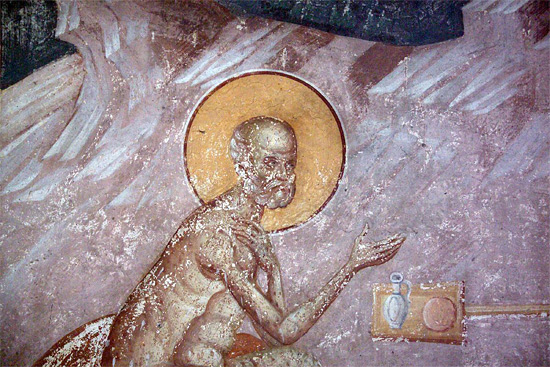
The Old Testament is revealed in the New Testament. The Book of Job reveals its meaning in an amazing way. It is read during the church services during Great Lent. This book prepares us to meet with the Suffering and Risen Christ.
The Sanctification of Holy Myrrh in the Orthodox Church
An Explanation of the Holy Myron
By Rev. S.T. Kezios