Saturday, 4 May 2013

Patriarch Theophilos of Jerusalem 
on the Holy Light

In an interview with the National Herald, Patriarch Theophilos of Jerusalem answered a few questions of interest regarding the annual miracle of the Holy Light (Holy Fire) which is celebrated in the Holy Sepulchre every Holy Saturday afternoon.

Regarding this Holy Light which although many say is a great miracle of Orthodoxy, others propose various theories to debunk this miracle, Patriarch Theophilos says the following:

"All the various perspectives and theories regarding the Holy Light come from people who are in complete ignorance, they have no religious sentiment even when they are disputed, and they do not want to receive the mystery of the divine economy, namely the Incarnation, beyond which I think all other things are redundant."

SYNAXARION
 GREAT AND HOLY SATURDAY

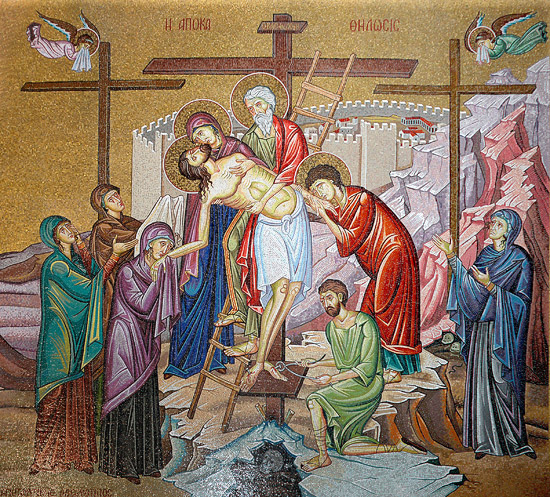
Taking the Savior down from the cross. Church of the Resurrection in Jerusalem. Photo: Anton Pospelov/Pravoslavie.ru
Of all the days the Holy and Great Forty Day Fast is the most distinguished, but more than the Holy Forty Day Fast the Holy and Great Passion Week is exalted, and more than the days of Holy Week Great and Holy Saturday is the most exalted. This week is called great not because these days or hours are more exalted but because the great, portentous and extraordinary deeds of our Savior were accomplished during this week, but especially on this day.
10 Reasons I Believe the
 Holy Light Is a Miracle 

Introduction

For nearly seventeen centuries an annual event has taken place at the Church of the Holy Sepulchre in Jerusalem on Holy Saturday (according to Orthodox Christian reckoning) that is today reported by media outlets around the world and hailed by tens of millions as one of Christianity's greatest miracles. The event is known to non-Orthodox as the ceremony of the "Holy Fire", while Orthodox prefer to call it "Holy Light" because they claim without hesitation it has a divine origin and supernatural qualities.
A Prayer Before the All-Holy Sepulchre
By Fr. Mitrophanes, Guardian of the Holy Sepulchre

Lord Jesus Christ our God, Who art Risen from the dead, receive our prayers and supplications and also my pilgrimage to Thine All-Holy Tomb; and raise us up, Who art Risen from the dead, granting Thy resurrection to all, and raising all who have fallen. To bring us into communion and show us Thy Resurrection, Thou didst descend into Hades. To illumine our darkness, Thou camest as Light into the darkness and dispelled the darkness of Hades, and as an arrow and lightning and uncreated tongues of fire the Holy Light of Thy Resurrection illumines our darkness and purifies our vision. Thou art our Resurrection from the sufferings of life.


HOLY SATURDAY

On Great and Holy Saturday the Orthodox Church commemorates the burial of Christ and His descent into Hades. It is the day between the Crucifixion of our Lord and His glorious Resurrection. The Matins of Holy Saturday is conducted on Friday evening, and while many elements of the service represent mourning at the death and burial of Christ, the service itself is one of watchful expectation.


Commemoration of Holy Saturday
On Great and Holy Saturday the Church contemplates the mystery of the Lord's descent into Hades, the place of the dead. Death, our ultimate enemy, is defeated from within. "He (Christ) gave Himself as a ransom to death in which we were held captive, sold under sin. Descending into Hades through the Cross ... He loosed the bonds of death" (Liturgy of St. Basil).


HOLY SATURDAY

 'WITH FEAR AND TREMBLING'

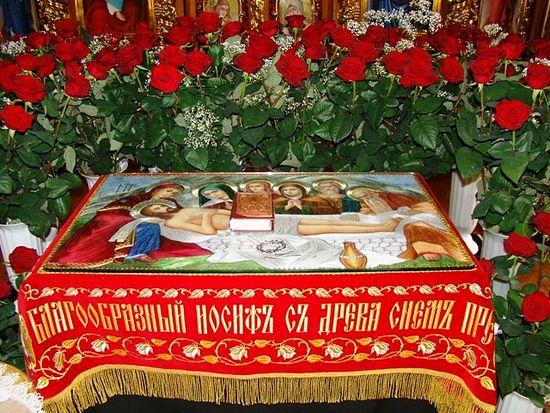
The epitaphion, in Russian plaschanitsa, or symolic winding sheet of Christ.
Miraculously, Orthodox Christianity has preserved the essence of "the faith once for all delivered to the saints" (Jude 3). By the sheer grace of God, it has maintained the apostolic faith in the face of extraordinary pressures, from persecution and martyrdom to Western secularism and pluralism. Without that grace, Orthodoxy would have disappeared before the end of the first millennium. And with it would have disappeared "true belief and "true worship."

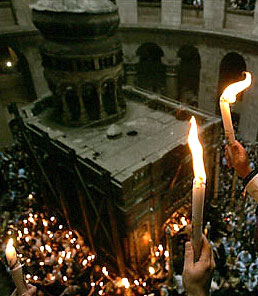
The Holy Edicule after the descent of the Holy Fire
THE HOLY FLAME
THE GREATNESS OF THE MIRACLE, AND THE HELPLESSNESS OF THE SKEPTICS

Why do atheists and skeptics want to destroy faith?

The Holy Edicule after the descent of the Holy Fire
During the long history of Christianity, there has never been a single miracle that skeptics and atheists have not tried to disprove. They have used and still use every possible means in this bat­tle. Even St. John Chrysostom talked about those [the chief priests and Pharisees] who denied the miracle of the Resurrection, saying, “But note, I pray thee, their plotting, how ridiculous it is.


Procession around the church with the winding sheet (epitaphion) at the Holy Saturday Matins service. Photo: St. Mary Magdalene Church, Fenton, MI
GREAT AND HOLY SATURDAY
THE FORGOTTEN FEAST
by Daniel Manzuk

Procession around the church with the winding sheet (epitaphion) at the Holy Saturday Matins service. Photo: St. Mary Magdalene Church, Fenton, MI

It is a tragic fact that today Holy Saturday is viewed by many as an unimportant “day off” between the sorrow of Good Friday and the joy of Pascha. This is absolutely false.


THE ORTHODOX CELEBRATION 
OF GREAT AND HOLY SATURDAY
By Fr. Alexander Schmemann

Great and Holy Saturday is the day on which Christ reposed in the tomb. The Church calls this day the Blessed Sabbath. The great Moses mystically foreshadowed this day when he said: God blessed the seventh day. This is the blessed Sabbath. This is the day of rest, on which the only-begotten Son of God rested from all His works. . . . (Vesperal Liturgy of Holy Saturday)

By using this title the Church links Holy Saturday with the creative act of God. In the initial account of creation as found in the Book of Genesis, God made man in His own image and likeness. To be truly himself, man was to live in constant communion with the source and dynamic power of that image: God. Man fell from God. Now Christ, the Son of God through whom all things were created, has come to restore man to communion with God. He thereby completes creation. All things are again as they should be.
Jesus In Hades and the Sign of Jonah

Jesus and the Sign of Jonah (Matthew 12:38-41)

Then certain of the scribes and of the Pharisees answered, saying, "Master, we would like to see a sign from thee."

But he [Jesus] answered and said unto them, "An evil and adulterous generation seeketh after a sign; and there shall no sign be given to it, but the sign of the prophet Jonah: For as Jonas was three days and three nights in the whale's belly; so shall the Son of man be three days and three nights in the heart of the earth. The men of Nineveh shall rise in judgment with this generation, and shall condemn it: because they repented at the preaching of Jonah; and, behold, a greater than Jonah is here."