Showing posts with label 1. Sunday of Zacchaeus. Show all posts

Tuesday, 27 January 2015

Homily on the Sunday of Zacchaeus

St. Ignatius (Brianchaninov) 

For the Son of man is come to seek and to save that which was lost (Lk. 19:10) 

Beloved brethren! These merciful words that we hear today in the Gospel are spoken by God become man about the sinner whom God’s righteous judgment had pronounced lost, but who was sought out by the power and grace of redemption, and numbered by it among the saved.

The sinner, Zacchaeus, was a publican with seniority over other publicans. He possessed significant wealth, as the Gospels relate, hinting about the way he obtained that wealth. “Publicans” were what they called tax collectors. It was tempting money! The sparkle of gold and silver charms the eyes of Adam’s descendants infected with sinfulness, and where money passes from hand to hand, abuse almost inevitably creeps in. Publicans were for the most part prone to extortion. When extortion becomes a passion it allows itself all manner of coercion and oppression against one’s neighbor. Then the passion of deceit and hypocrisy comes to the aid of the passion of extortion. From this combination comes the tendency towards captiousness, latching onto every trifle under the pretext of relentlessly fulfilling the laws, inventing guilt for the guiltless, exerting every effort to create an appearance of justness to conceal this inhuman oppression and cruelty against one’s neighbors. Because of this behavior publicans were horrible to the people, and held in contempt by moral people. Zacchaeus was a chief publican; his abuses were greater than those of his underlings. There is a reason why the Gospels point out that he was rich! He became rich unrighteously—his sin was extortion. His soul’s illness was filthy lucre and the mercilessness and lack of compassion that comes from it. Because of his serious sins and criminal disposition of soul, Zacchaeus was called “lost”. Not people’s light-minded, often mistaken condemnation called him lost—God Himself pronounced this judgment upon him. Zacchaeus had become a hardened sinner; in order to amass wealth through abuses one has to do so persistently and for a long time.

Friday, 14 February 2014

Meeting of the Lord and Zacchaeus


Giotto, Presentation of Christ at the Temple,
1306, Scrovegni (Arena) Chapel, 
 Padua, Italy
Fr. John Behr

A homily delivered in the Three Hierarchs Chapel at St. Vladimir’s Orthodox Theological Seminary on the Feast of the Meeting of the Lord in the Temple and Zacchaeus Sunday (Sunday, February 2, 2014).

Today, as we celebrate the meeting of Christ and the righteous Simeon and Anna, in the temple, we come to an end of a series of feasts that have taken us through the darkness of the long and cold winter nights: a series of feasts bringing out different aspects of God’s search or outreach to us: the Word becoming flesh in the small dark cavern, in the depths of the earth, the manifestation of God to us, through the passage through the waters.

And now, in obedience to the Mosaic Law, forty days after his birth, Christ, the first-born son, is brought to the temple so that he might complete the law, and the law might be completed by him.

Saturday, 8 February 2014


Zacchaeus


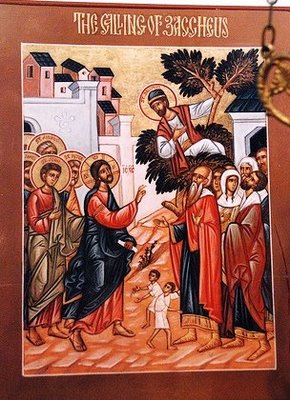
Jesus entered and passed through Jericho. And, behold, there was a man named Zacchaeus, which was the chief among the publicans, and he was rich. And he sought to see Jesus who he was; and could not for the press, because he was little of stature. And he ran before, and climbed up into a sycomore tree to see him: for he was to pass that way. And when Jesus came to the place, he looked up, and saw him, and said unto him, Zacchaeus, make haste, and come down; for to day I must abide at thy house. And he made haste, and came down, and received him joyfully. And when they saw it, they all murmured, saying, That he was gone to be guest with a man that is a sinner. And Zacchaeus stood, and said unto the Lord; Behold, Lord, the half of my goods I give to the poor; and if I have taken any thing from any man by false accusation, I restore him fourfold. And Jesus said unto him, This day is salvation come to this house, forsomuch as he also is a son of Abraham. For the Son of man is come to seek and to save that which was lost (Lk. 19:1-10).
Jesus entered and passed through Jericho. And, behold, there was a man named Zacchaeus, which was the chief among the publicans, and he was rich. And he sought to see Jesus who he was; and could not for the press, because he was little of stature. And he ran before, and climbed up into a sycomore tree to see him: for he was to pass that way. And when Jesus came to the place, he looked up, and saw him, and said unto him, Zacchaeus, make haste, and come down; for to day I must abide at thy house. And he made haste, and came down, and received him joyfully. And when they saw it, they all murmured, saying, That he was gone to be guest with a man that is a sinner. And Zacchaeus stood, and said unto the Lord; Behold, Lord, the half of my goods I give to the poor; and if I have taken any thing from any man by false accusation, I restore him fourfold. And Jesus said unto him, This day is salvation come to this house, forsomuch as he also is a son of Abraham. For the Son of man is come to seek and to save that which was lost (Lk. 19:1-10).

Sunday, 26 January 2014

Sunday of Zaccheus

I Timothy 4:9-15
Luke 19:1-10

As every seasoned Orthodox Christian knows, when we come to the Sunday of Zaccheus, Great Lent is only four weeks away. Already, the aura of the Church is taking on the hint of the sweet fragrance that announces the coming of that blessed season, and the hearts of the faithful quicken in holy anticipation.

On the Sunday of Zacchaeus

by Metropolitan Anthony of Sourozh

Last week we have entered into the several weeks on our way to the day of the Resurrection, when we are told to examine ourselves; then a time will come to think of nothing but the ways of God preparing us for salvation; and when we reach Holy Week, then we should have no thought, anything but the Lord Whose passion we will be contemplating before we enter together with Him into the glory and the joy of His Resurrection.

Last week we read the Gospel of the Blind man of Jericho; it challenges us directly; we all contend that we see; we all contend that we are not blind, and yet is not the way in which we see another form of blindness? Are we not blinded by the visible to the invisible, are we not blinded by prejudice against truth, are we not blinded by passion against reality? And so, each of us has got to ask himself whether what he sees is the reality of things, and if not, turn to God asking Him to give us an insight. And one of the things that blinds us most hopelessly is vanity that makes us accept for true all the lies we may hear or observe which boost our self-respect, which make us reject everything which is criticism or condemnation of us.

Sermon on the Gospel of the Sunday of Zacchaeus


In the name of the Father and of the Son and of the Holy Spirit, Amen. My beloved Christians, in today's Gospel we read about something which was a common occurrence in the latter years of the life of our Lord and Saviour Jesus Christ.

As we know, once our Lord was baptized, He no longer dwelt as He did formerly in His home in the city of Nazareth. He had embarked upon His mission to spread the Gospel of salvation to all the people in the area of Palestine. He went from town to town, wandering over all the country roads. When He came to a particular town or city, if there were God-fearing people who dwelt there who would offer Him and His disciples something to eat and a place to sleep, all well and good; if not, then our Lord, along with His disciples, would find some other place to spend the night.

The Sunday of Zacchaeus[1]

Synaxarion of the Lenten Triodion and Pentecostarion

On this day, the Sunday before the beginning of the Lenten Triodion, we commemorate the repentance of the tax-collector, the Holy Apostle Zacchaeus, who desired to behold Christ.

The Holy Fathers placed today's commemoration here to prepare us, little by little, for dawning season of Great Lent. Knowing that we are basically slow to exhibit a desire for repentance, the Holy Fathers, by Zacchaeus' example, teach us in these preliminary weeks the need to recognize our sins and our need to turn away from them.

Staying Focused (15th Sunday of Luke : Zacchaeus)

by Fr. Peter Chamberas

One of the greatest advantages of our culture is that its diverseness offers us choices and opportunities that have not existed before. More and more citizens are rejecting convention and finding their own way.

One of the greatest disadvantages of our culture is that its diverseness offers us choices and opportunities that have not existed before. More and more citizens are rejecting convention and finding their own way.

From The Explanation of the Gospel of St. Matthew

Zacchaeus Sunday

Luke 19:1-10

by Blessed Theophylact, Archbishop of Ochrid and Bulgaria

1-10. And Jesus entered and passed through Jericho. And, behold, there was a man named Zacchaeus, who was a chief publican, and he was rich. And he sought to see Jesus who He was, and could not for the crowd, because he was of little stature. And he ran before, and climbed up into a sycamore tree to see Him: for He was to pass that way. And when Jesus came to the place, He looked up, and saw him, and said unto him, Zacchaeus, make haste, and come down: for today I must abide at thy house. And he made haste, and came down, and received Him joyfully. And when they saw it, they all murmured, saying, He has gone to be guest with a man that is a sinner. And Zacchaeus stood, and said unto the Lord; Behold, Lord, the half of my goods I give to the poor; and if I have taken any thing from any man by false accusation, I restore him fourfold. And Jesus said unto him, This day is salvation come to this house, forsomuch as he also is a son of Abraham. For the Son of Man is come to seek and to save that which was lost. 

Zacchaeus Of Little Stature

By St. Nikolai Velimirovich

"Today, salvation has come to this house" (Luke 19:9).

Thus it was spoken by the One Whose word is life and joy and restoration of the righteous. Just as the bleak forest clothes itself into greenery and flowers from the breath of spring, so does every man, regardless of how arid and darkened by sin, becomes fresh and youthful from the nearness of Christ. For the nearness of Christ is as the nearness of some life-giving and fragrant balsam which restores health, increases life, give fragrance to the soul, to the thoughts and to the words of man. In other words, distance from Christ means decay and death and His nearness means salvation and life.

Sunday of Zacchaeu - The Lenten Journey Begins

The paschal season of the Church is preceded by the season of Great Lent, which is also preceded by its own liturgical preparation. The first sign of the approach of Great Lent comes five Sundays before its beginning. On this Sunday the Gospel reading is about Zacchaeus the tax-collector. It tells how Christ brought salvation to the sinful man, and how his life was changed simply because he "sought to see who Jesus was" (Luke 19:3). The desire and effort to see Jesus begins the entire movement through Lent towards Pascha. It is the first movement of salvation.

Our lenten journey begins with a recognition of our own sinfulness, just as Zacchaeus recognized his. He promised to make restitution by giving half of his wealth to the poor, and by paying to those he had falsely accused four times as much as they had lost. In this, he went beyond the requirements of the Law (Ex. 22:3-12).

Sunday of Zacchaeus

The Church remembers Zacchaeus on the Sunday of Zacchaeus, when Luke 19:1-10 is read, describing his encounter with Christ.
In the Slavic lectionary, the Sunday of Zacchaeus is also the Sunday before the Triodion begins (though in the Byzantine lectionary, it may occur earlier). It is read at this point in the liturgical year, immediately before Great Lent, to teach that one should turn away from sins.

In this way the Lenten journey should begin with a recognition of sinfulness, just as Zacchaeus recognized his sins. He promised to make restitution by giving half of his wealth to the poor and by paying to those he had falsely accused four times as much as they had lost. In this, he went beyond the requirements of the Law (Ex. 22:3-12).

Just as Zacchaeus "sought to see who Jesus was" (Luke 19:3), that same desire and effort to see Jesus starts the movement through Lent towards Pascha. It is the first movement of salvation.